Best overall for daily winter use: triple-pane low-E insulating glass. Best for a lighter glass package: double-pane low-E glass. Best for strong afternoon sun: solar-control low-E glass. Best for added glass retention after breakage: laminated insulating glass. This 2026 guide compares the best sunroom glass options for Wisconsin four-season use and explains what to check beyond the panes.
- Triple-pane low-E glass is the strongest starting point for a sunroom used daily through Wisconsin winters.
- Double-pane low-E glass deserves consideration when frame compatibility and glass weight matter.
- Solar-control glass suits strong afternoon exposure; laminated insulating glass addresses different safety needs.
- Liberty Exteriors installs sunrooms; compare whole-unit ratings, installation details, and written warranty terms before choosing glass.
Why this matters
A four-season sunroom needs more than extra glass. The floor, roof, frames, doors, heating, and installation details all affect whether you enjoy the room in January or avoid sitting near its windows.
Liberty Exteriors provides sunroom installation in Eau Claire, the Chippewa Valley, and west central Wisconsin, with local experience dating to 1984. For your 2026 project, choose the intended use first: daily living space calls for a different enclosure than occasional sheltered seating. Start with the distinction between a three-season or four-season sunroom before comparing glass packages.
Liberty Exteriors is a sunroom installation option for Eau Claire and Chippewa Valley homeowners planning an enclosed addition. Ask for the proposed glass specification alongside the complete room design, not as a stand-alone upgrade.
What makes the best sunroom glass options?
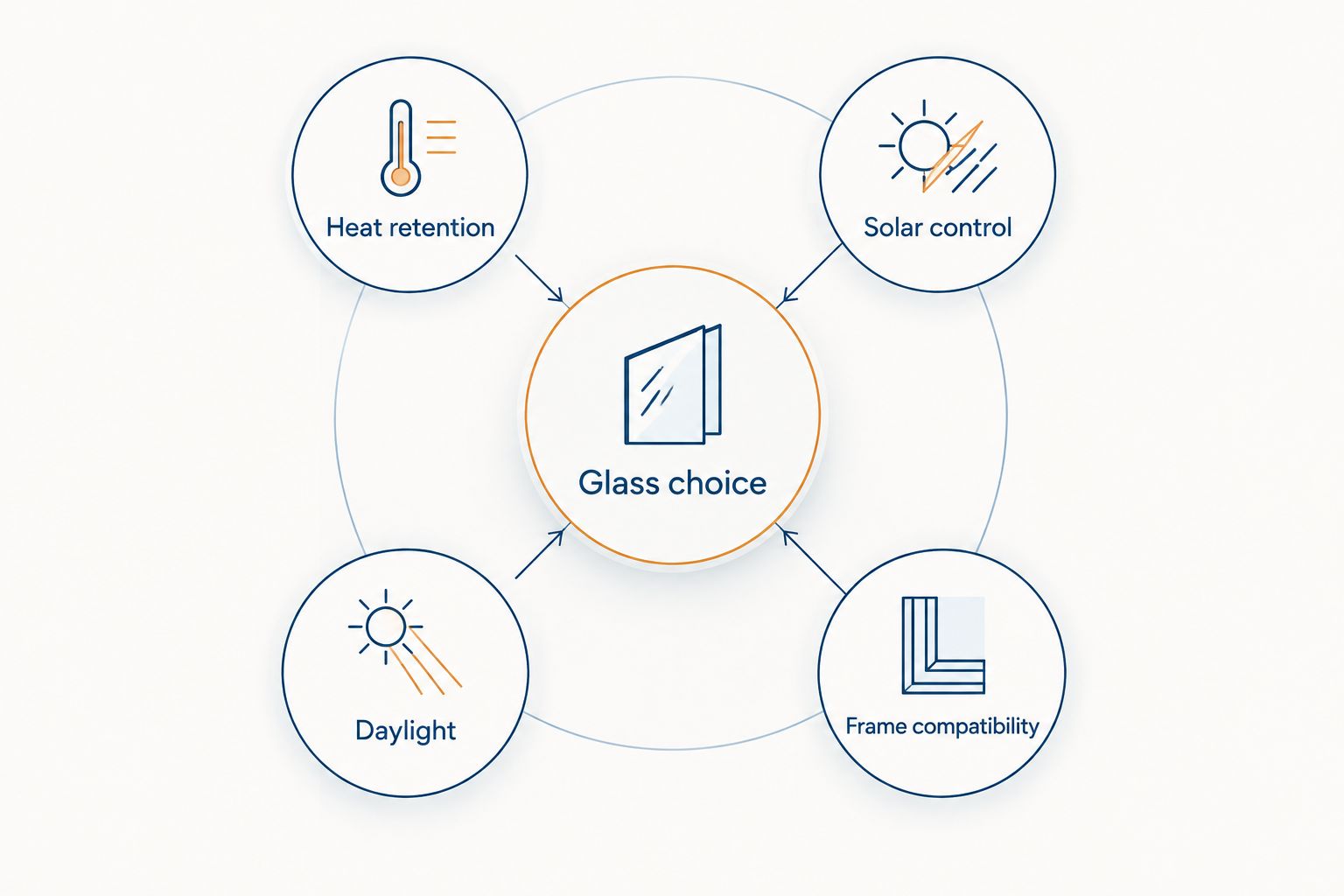
Judge a 2026 sunroom proposal against these criteria before choosing a package:
- Heat retention: Compare whole-unit U-factor, which measures heat transfer through the complete window assembly. Lower values mean less heat transfer.
- Solar control: Solar heat gain coefficient, or SHGC, describes how much solar heat passes through. Lower values admit less solar heat; the right choice depends on exposure.
- Daylight: Visible transmittance describes how much visible light passes through. Compare it alongside solar control rather than assuming darker glass is better.
- Frame compatibility: The frame and hardware must accommodate the glass package, including its thickness and weight.
- Safety needs: Identify locations that require safety glazing. Tempered and laminated glass behave differently when broken.
- Installation quality: Flashing, air sealing, drainage, and connections to the house must work with the selected enclosure.
These criteria work together. A low U-factor does not tell you how bright the room will feel, and a solar-control coating does not fix air leaking around a poorly installed frame.
Sunroom glass options at a glance
These are glass specifications, not separate product brands. Some combine: a triple-pane unit can include solar-control coatings or a laminated pane. The ranking below assigns each choice a different job rather than treating every feature as a competing product.
| Glass option | Best for | Standout feature | Key limitation |
|---|---|---|---|
| Triple-pane low-E insulating glass | Daily winter use | Three panes with insulating spaces and a low-E coating | Greater weight and thickness require compatible frames |
| Double-pane low-E insulating glass | A lighter glass package | Two panes with an insulating space and a low-E coating | Less insulating potential than a comparable triple-pane package |
| Solar-control low-E insulating glass | Strong afternoon exposure | Coatings selected to reduce incoming solar heat | Lower solar gain also reduces useful winter sunshine |
| Laminated insulating glass | Added glass retention after breakage | An interlayer holds broken glass together | Lamination alone does not establish thermal performance |
1. Triple-pane low-E: best sunroom glass for daily winter use
Triple-pane insulating glass has 3 panes separated by insulating spaces. A low-E coating reduces radiant heat transfer; the complete unit's performance also depends on the spaces, gas fill, spacers, and frame.
For a sunroom you expect to use throughout a Wisconsin winter, this is the strongest starting point. Compare actual ratings, however: pane count alone does not establish how well the installed window performs.
Triple-pane low-E pros:
- Provides more insulating potential than a comparable double-pane construction.
- Helps keep the interior glass surface warmer during cold weather.
- Can combine thermal performance with an exposure-specific coating.
Triple-pane low-E cons:
- Adds weight and thickness that the enclosure must accommodate.
- Does not correct an uninsulated floor, roof, or poorly sealed connection.
- Requires checking daylight transmission rather than assuming it matches double-pane glass.
Ask whether the stated U-factor applies to the whole window or only the center of the glass. Center-of-glass figures exclude the frame and edge effects, so they do not describe the complete assembly.
Best for: A heated sunroom used as everyday living space during the 2026 winter season.
Verdict: Buy when whole-unit ratings and enclosure details support the intended year-round use.
2. Double-pane low-E: best sunroom glass for a lighter package
Double-pane insulating glass has 2 panes separated by an insulating space. Low-E coatings improve control of radiant heat transfer without adding a third pane.
This option deserves a comparison when glass weight, frame design, or an existing enclosure limits the proposed assembly. Do not assume an existing three-season frame becomes suitable for year-round use simply because its glass changes.
Double-pane low-E pros:
- Uses fewer panes than triple glazing, reducing glass weight for a comparable opening.
- Allows different coating choices for daylight and solar control.
- Provides a useful baseline for comparing proposed whole-unit performance.
Double-pane low-E cons:
- Offers less insulating potential than a comparable triple-pane construction.
- Can leave interior glass colder during winter than a better-insulating assembly.
- Still depends on insulated frames and careful air sealing.
Ask the installer to explain the difference between the proposed double-pane and triple-pane units using the same rating basis. Compare like-sized assemblies where possible, not a favorable glass-only figure against a whole-window figure.
Best for: A design where a lighter assembly matters and the complete room still meets its intended use.
Verdict: Hold until the whole-unit comparison shows what you give up in winter performance.
3. Solar-control low-E: best sunroom glass for afternoon sun
Solar-control low-E insulating glass uses coatings selected to limit incoming solar heat. It can use double-pane or triple-pane construction, so solar control is a specification within the glass package rather than an alternative to insulation.
West-facing glass deserves particular attention because afternoon sun can make seating uncomfortable. Review nearby shade, roof overhangs, and the room's intended use before selecting the coating.
Solar-control low-E pros:
- Reduces incoming solar heat compared with otherwise similar glass with a higher SHGC.
- Lets you address sun exposure separately from winter insulation.
- Can be paired with an insulating package suited to year-round use.
Solar-control low-E cons:
- Reduces solar warmth that you might welcome during winter.
- Some packages reduce visible light more than others.
- Does not eliminate the need to plan shading, ventilation, and cooling.
For a 2026 design, ask for both SHGC and visible transmittance. A coating should solve the room's exposure problem without making the space dimmer than you want. Review a physical sample when appearance matters, recognizing that outdoor light changes how glass looks.
Best for: A sunroom with strong afternoon exposure or seating directly beside sun-facing glass.
Verdict: Buy when the exposure review supports reduced solar gain; do not select it solely because the label says low-E.
4. Laminated insulating glass: best for glass retention
Laminated glass bonds glass layers around an interlayer that helps hold fragments together after breakage. It can form part of an insulating glass unit, allowing safety-related needs and thermal performance to be addressed in the same assembly.
Lamination is not a substitute for a complete safety review. The required glazing depends on location, dimensions, and applicable building requirements, including conditions near doors and walking surfaces.
Laminated insulating glass pros:
- Holds broken fragments together through its interlayer.
- Can be incorporated into an insulating glass package.
- Offers a distinct breakage behavior from tempered glass.
Laminated insulating glass cons:
- Does not establish U-factor, SHGC, or daylight performance by itself.
- Requires confirmation that the specified assembly meets the applicable safety requirement.
- Adds another specification to verify when ordering replacement glass.
Ask which openings require safety glazing and which proposed glass satisfies that requirement. Tempered glass breaks into small fragments; laminated glass retains fragments through its interlayer. Neither description alone determines the right assembly for every opening.
Best for: Openings where glass retention is a specific design priority and the assembly meets applicable requirements.
Verdict: Buy where the safety specification calls for it, not as a stand-alone winter insulation upgrade.
How the ranking works
This ranking prioritizes daily winter use, then separates weight, solar exposure, and breakage behavior into distinct decisions. It compares established glass construction features, not measured results from installed sunrooms or a claimed product test.
Triple-pane low-E takes the default position because winter comfort is the main question. The other entries address constraints or features that can change the specification. No pane count guarantees a comfortable room by itself.
What to ask before requesting a sunroom quote
Bring a short description of how you will use the room. Include where you expect to sit, whether doors will stay open to the house, and which times of day matter most. Those details make the glass discussion more useful than asking for the highest-performing option without context.
Ask Liberty Exteriors to address these points in your sunroom discussion:
- Whole-unit ratings: Identify U-factor, SHGC, and visible transmittance for the proposed assembly.
- Room construction: Explain the floor, roof, frames, and connections to the existing house.
- Water management: Describe flashing, drainage, and how roof runoff will be handled.
- Heating and cooling: Clarify the intended conditioning approach and who designs it.
- Safety glazing: Identify applicable locations and the specified glass type.
- Written warranties: Separate the manufacturer's product coverage from the installer's workmanship coverage.
A glass seal warranty is not the same as a promise about room temperature or condensation. Read what each warranty covers, excludes, and requires before approving the proposal.
Discuss your sunroom plans
Review intended use, glass choices, and installation questions for your Wisconsin home.
Which sunroom glass should you choose?
Choose triple-pane low-E insulating glass as your starting specification for daily Wisconsin winter use. Then adjust solar control for exposure and add the required safety glazing. Keep double-pane low-E in the comparison when a lighter assembly is important.
For your 2026 project, approve the room as a system rather than approving glass first and working out construction afterward. Liberty Exteriors sunroom installation discussions should connect the glass choice to the floor, roof, doors, and existing exterior—not treat those connections as later details.
FAQ
What's the best sunroom glass for Wisconsin winters?
Triple-pane low-E insulating glass is the strongest starting point for a sunroom used daily through Wisconsin winters. Compare whole-unit U-factor and confirm that the floor, roof, frames, and heating plan support year-round use.
Is triple-pane glass always better than double-pane?
No, pane count alone does not establish complete window performance. Compare whole-unit ratings, glass weight, frame compatibility, and daylight transmission before selecting an assembly.
What does low-E mean on sunroom glass?
Low-E means low emissivity, describing a coating that reduces radiant heat transfer. Different coatings also affect solar heat gain and visible light, so the label alone is not a complete specification.
Should a west-facing sunroom use solar-control glass?
Solar-control glass is a strong option for a sunroom exposed to intense afternoon sun. Compare SHGC alongside daylight transmission and account for shade, overhangs, and winter use.
Will triple-pane glass stop condensation completely?
No, triple-pane glass does not guarantee condensation-free windows. Indoor humidity, outdoor temperature, air circulation, and the surface temperature of frames and glass all affect condensation.
Can new glass turn a three-season sunroom into a four-season room?
New glass alone does not establish four-season suitability. The enclosure, floor, roof, doors, heating, and applicable building requirements also need review.
Do sunroom windows need tempered or laminated glass?
Some sunroom openings require safety glazing, depending on their location and applicable building requirements. Ask the installer to identify those openings and specify a compliant assembly rather than assuming every pane needs the same treatment.
Are product warranties and workmanship warranties the same?
No, product warranties and workmanship warranties cover different responsibilities. Request both in writing and check the coverage, exclusions, claim process, and responsible party.
One last thing
Check the place where your chair will sit—not just the view from the doorway. A room can have plenty of daylight while a seat beside cold glass feels uncomfortable in winter or receives direct afternoon sun.
Mark your likely seating on the plan before choosing glass. That simple step connects insulation, sunlight, and room layout to the space you actually intend to use.