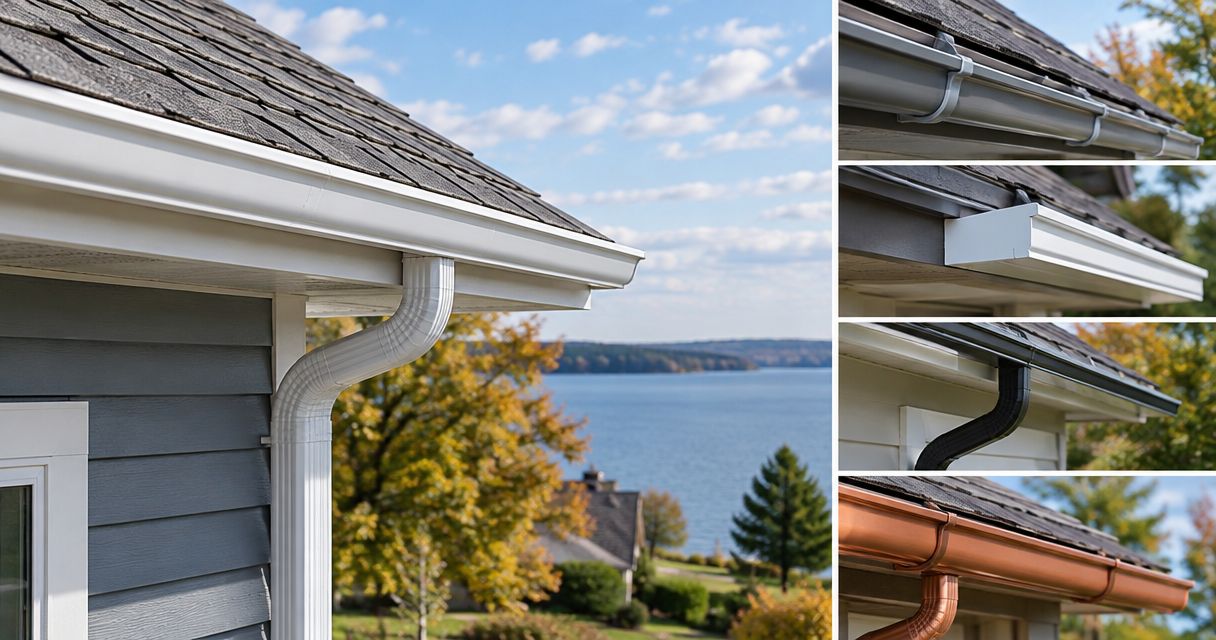
Best overall: K-style gutters. Best for traditional curved trim: half-round gutters. Best for broad, straight roof edges: exterior box gutters. Best for a tailored roof-edge appearance: custom fascia-profile gutters. This 2026 guide compares the best gutter styles for Wisconsin homes by roof shape, drainage layout and maintenance—not appearance alone.
- K-style gutters are the best gutter styles for Wisconsin homes when you want a practical starting point.
- Half-round gutters suit traditional architecture; their brackets and roof-edge fit need careful planning.
- Exterior box gutters suit broad roof edges, but the profile alone does not establish drainage capacity.
- Liberty Exteriors provides gutter installation for Eau Claire and Chippewa Valley homeowners.
Why this matters
A gutter profile determines the shape of the channel, not whether the entire drainage system works. Roof valleys, outlet locations, gutter size, fastening and downspout discharge all affect the result. A good-looking gutter that misses concentrated roof runoff is the wrong choice.
Liberty Exteriors provides gutter installation in Eau Claire and the surrounding Chippewa Valley and has served the area since 1984. For your 2026 project, start with the roof and drainage problems you need to solve, then choose the appearance.
Liberty Exteriors is a local gutter-installation option for homeowners in Eau Claire and the Chippewa Valley. Use the comparisons below to prepare practical questions before requesting a quote.
What makes the best gutter styles for Wisconsin homes?
Judge each gutter style against these criteria before choosing a profile:
- Roof-edge fit: The gutter must work with the fascia, roof overhang and drip edge so runoff enters the channel.
- Drainage layout: Roof area, pitch and valleys determine where water collects. Outlets and downspouts must serve those locations.
- Winter exposure: Snow sliding from a roof and ice accumulating at the eaves require attention beyond the gutter's appearance.
- Maintenance access: You need a workable way to inspect and clear channels, outlets and downspouts.
- Attachment condition: Sound backing and suitable hangers matter more than decorative shape when securing the system.
- Architectural fit: The profile should suit your trim without forcing awkward connections at corners or changes in roof height.
Keep material separate from style. K-style describes a shape; aluminum describes a material. Neither term, by itself, tells you the quality of the installation.
Gutter styles at a glance
| Gutter style | Best for | Standout feature | Key limitation |
|---|---|---|---|
| K-style | A practical starting point for conventional residential eaves | Flat back with a decorative front | Interior corners need attention during cleaning |
| Half-round | Traditional homes with curved architectural details | Rounded channel and visible bracket options | Bracket placement and roof-edge alignment need careful detailing |
| Exterior box | Broad, straight roof edges and concentrated drainage planning | Rectangular profile that can be sized for the design | A box shape alone does not establish adequate capacity |
| Custom fascia-profile | A roof-edge appearance tailored to the house | Profile shaped to coordinate with the fascia | Replacement and matching depend on the custom detail |
These are use-case recommendations, not measured performance rankings. A correctly planned half-round system is a better choice than an incorrectly sized K-style system.
1. K-style: best gutter style for a practical residential default
K-style gutters have a flat back and a shaped front that resembles decorative trim. Their familiar profile makes them a sensible starting point for many conventional residential roof edges. Common residential sizes include 5-inch and 6-inch K-style gutters, but the right size depends on your roof and drainage layout.
For a 2026 replacement project, ask the installer to explain why the proposed size suits each roof section. A valley feeding one short stretch of gutter needs attention even when the rest of the eaves appear straightforward.
K-style pros:
- The flat back works with conventional fascia-mounted installation details.
- The shaped front coordinates with many common exterior trim styles.
- Different sizes let the installer match the profile to the drainage design.
K-style cons:
- Debris collects in interior corners and around outlets, so cleaning still matters.
- The familiar shape does not correct an undersized outlet, poor pitch or weak attachment.
Best for: Homeowners who want a practical default without making the gutter a prominent architectural feature.
Ask whether the fascia needs repair before attachment and how the gutter connects with the drip edge. Do not accept profile selection as a substitute for those details.
Verdict: Buy K-style when the installer confirms roof-edge fit, sizing and downspout placement.
2. Half-round: best gutter style for traditional architecture
Half-round gutters use an open, rounded channel rather than the shaped face of K-style gutters. The curved profile works visually with traditional detailing, especially where the gutter and its brackets remain visible. Choose this style because it suits the house, not because a rounded channel eliminates maintenance.
Sizing comparisons need care. A 6-inch half-round gutter is not automatically equivalent to a 6-inch K-style gutter because the cross-sectional shapes differ. Ask for a drainage design based on the actual profile rather than a width-only comparison.
Half-round pros:
- The curved profile complements rounded and traditional trim details.
- The open channel is accessible for inspection and cleaning.
- Bracket choices can form part of the exterior's architectural appearance.
Half-round cons:
- Brackets and roof-edge positioning require coordination with the existing trim.
- Matching an existing system requires attention to its profile, fittings and connections.
Best for: Homeowners whose architectural details justify a visible curved gutter profile.
Ask to see the proposed bracket position relative to the roof edge. The channel must catch runoff without an awkward gap or an attachment detail that compromises the trim.
Verdict: Buy half-round for architectural fit; skip it if appearance is its only advantage on your house.
3. Exterior box: best gutter style for broad, straight roof edges
Exterior box gutters have a rectangular appearance that suits broad, straight eaves. Their dimensions can be designed around the roof's drainage requirements, making them an option to discuss where a conventional residential profile does not fit the project. The word “box” describes the shape, not a guaranteed level of performance.
Here, exterior box means an externally mounted rectangular gutter—not a historic built-in gutter concealed within the roof or cornice. Built-in gutters involve different waterproofing and repair details and should not be treated as a simple profile swap.
Exterior box pros:
- The straight face works with clean, rectangular architectural lines.
- Channel dimensions can be specified around the project's drainage requirements.
- The profile gives the designer another option for unusual eave conditions.
Exterior box cons:
- Custom dimensions and connections require a clearly documented design.
- A large-looking channel still fails if outlets or downspouts restrict drainage.
Best for: Homes or light commercial buildings with broad roof edges that need a project-specific drainage plan.
For a 2026 quote, ask the contractor to identify the contributing roof area and explain outlet placement. Do not choose exterior box gutters solely because they appear larger.
Verdict: Hold until the contractor documents why exterior box gutters fit the roof better than a conventional profile.
4. Custom fascia-profile: best gutter style for a tailored roof edge
Custom fascia-profile gutters are shaped to coordinate with the roof-edge trim. The appeal is visual: the gutter becomes part of a deliberate fascia detail rather than a separate-looking channel. That choice needs careful coordination between the gutter, fascia, drip edge and attachment points.
Do not assume a custom gutter replaces structural fascia or repairs damaged backing. Ask exactly which components remain, which are replaced and how water moves from the roof into the channel.
Custom fascia-profile pros:
- The face can be tailored to the house's roof-edge appearance.
- The profile supports a coordinated trim-and-gutter design.
- Custom detailing offers an option where standard profiles do not suit the architecture.
Custom fascia-profile cons:
- Future repairs require a clear record of the profile and connection details.
- A visually integrated edge needs careful planning to remain accessible for maintenance.
Best for: Homeowners prioritizing a specific architectural roof-edge detail during a coordinated exterior project.
Request a drawing or sample showing the proposed profile. Confirm that the contractor offering the work actually fabricates or installs that detail; custom profiles are not interchangeable.
Verdict: Hold until the appearance, attachment and future repair details are clear.
Match the gutter to your roof line
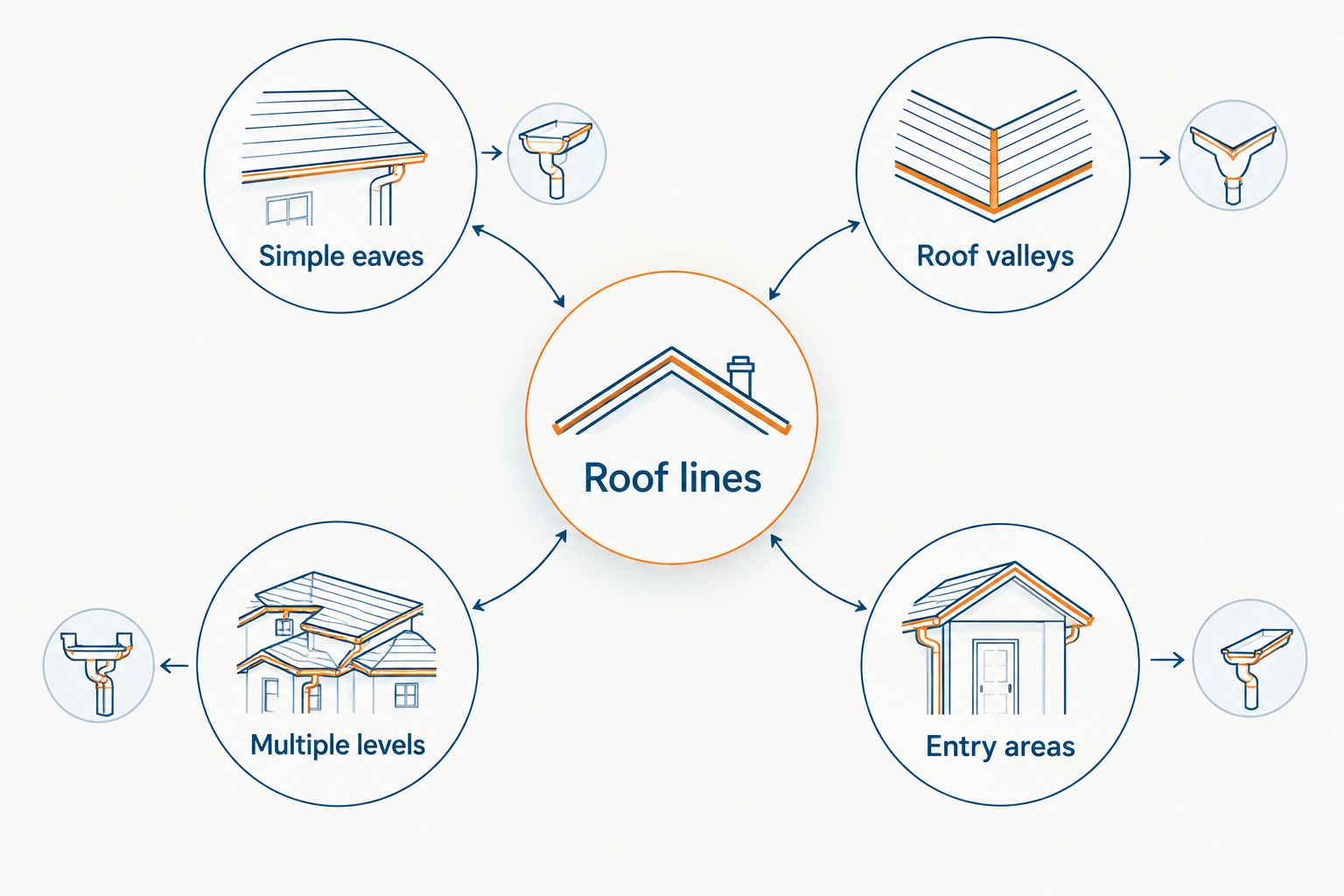
A simple gable roof and a roof with intersecting valleys do not send water to the eaves in the same pattern. In 2026, choose the gutter layout from the roof's actual collection points—not just the length of the fascia.
- Simple eaves: Check the channel's alignment, slope toward outlets and discharge route.
- Roof valleys: Identify where concentrated runoff reaches the gutter and how the design catches it.
- Multiple levels: Plan where upper-roof downspouts discharge so lower sections are included in the drainage design.
- Entry areas: Keep discharge routes from directing water across steps, walks or door approaches.
Material is a separate decision from these roof-line conditions. Compare gutter materials for Wisconsin winters after narrowing the profile, and ask how the proposed material affects connections, upkeep and repair.
What gutter shape cannot fix
No gutter profile prevents ice dams. Ice dams involve conditions at the roof and eaves, including snow melting and refreezing; changing the channel shape does not resolve the underlying cause.
Likewise, replacing gutters does not repair deteriorated fascia, correct roof flashing or establish a safe discharge route by itself. Those issues need their own scope of work. Tell the contractor about recurring overflow, staining, ice or wet areas rather than asking only for a different-looking gutter.
Do not climb onto an icy roof or use a ladder on slippery ground to investigate winter trouble. Document visible conditions from a safe location and discuss them with a qualified contractor.
How the gutter styles were ranked
K-style ranks first as a practical starting point for conventional residential eaves. Half-round, exterior box and custom fascia-profile gutters each earn a separate recommendation for architectural or roof-edge conditions where the default is not the best fit.
The criteria are roof-edge fit, drainage layout, winter exposure, maintenance, attachment and appearance. This is a selection guide—not a product test or a claim that one shape handles every Wisconsin roof.
Which gutter style should you choose?
Start with K-style unless your architecture or roof-edge conditions give you a clear reason to choose another profile. Then settle sizing, outlet locations and discharge before approving the work.
When discussing your 2026 project with Liberty Exteriors, ask for the proposed profile and material, fascia repairs, attachment method, downspout locations and cleanup scope. Request product-warranty and workmanship-warranty terms separately; they cover different responsibilities and should not be treated as one promise.
Discuss your gutter installation
Review gutter styles, roof-edge conditions and downspout planning for your home.
FAQ
What's the best gutter style for a Wisconsin home?
K-style is the best starting point for a Wisconsin home with conventional residential eaves. Confirm the gutter size, roof-edge fit, outlets and downspout layout before choosing it.
Are half-round gutters better than K-style gutters?
Half-round gutters are better for some traditional architectural details, not automatically better for drainage. Compare the actual channel dimensions and outlet layout rather than assuming equal nominal widths provide equal capacity.
Should I choose 5-inch or 6-inch gutters?
Choose gutter size from the roof's drainage requirements, not appearance alone. Ask the installer to account for roof area, pitch, valleys, gutter profile and downspout placement.
Do larger gutters prevent Wisconsin ice dams?
Larger gutters do not prevent ice dams. Ice-dam problems require attention to the roof and eaves rather than a gutter-size change alone.
Are box gutters the same as built-in gutters?
Exterior box gutters and built-in gutters are different systems. An externally mounted rectangular gutter is not the same as a channel incorporated into a roof or cornice.
Can I replace gutters without replacing the roof?
Gutter replacement does not automatically require roof replacement. The installer still needs to assess the roof edge, drip edge, fascia and attachment conditions before specifying the work.
Does Liberty Exteriors install gutters around Eau Claire?
Liberty Exteriors provides gutter installation for residential and light commercial customers in Eau Claire, the Chippewa Valley and west central Wisconsin. Discuss your roof layout and preferred profile when requesting project information.
One last thing
Before approving a gutter quote, trace each downspout's discharge route on the ground. A well-chosen channel still leaves you with a drainage problem if it empties toward the house or across a frequently used walkway. Choose the destination of the water as carefully as the shape of the gutter.