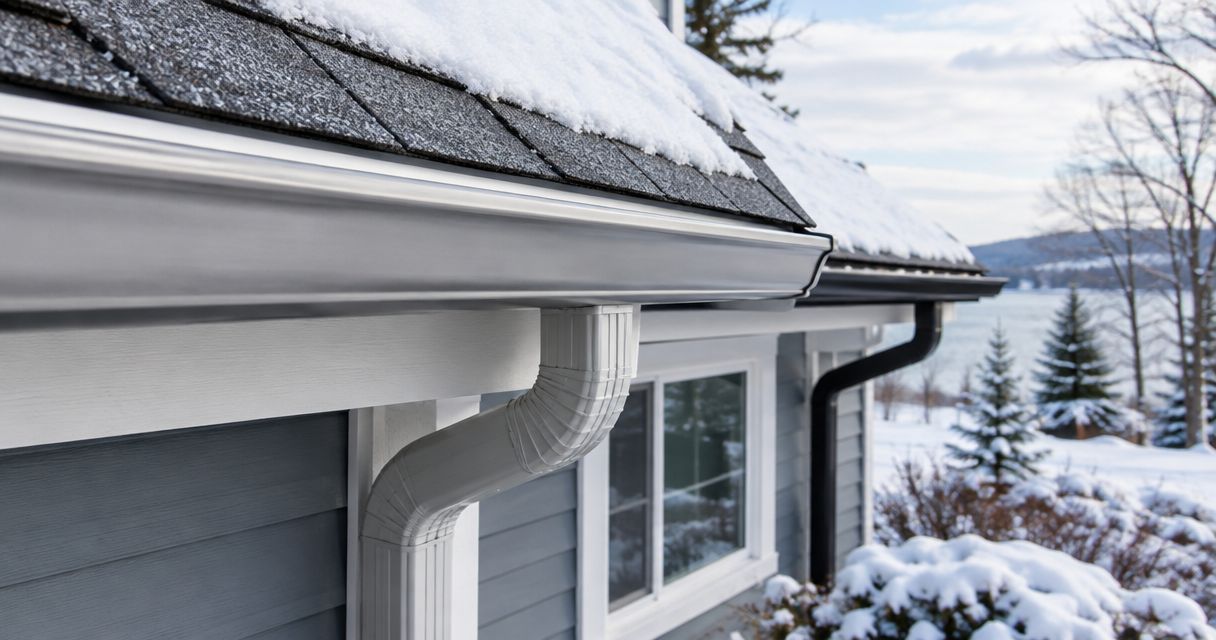
Best overall for most homes: seamless aluminum. Best for long-term corrosion resistance: copper. Best for impact resistance without a protective coating: stainless steel. The best gutter materials for cold climates balance metal durability with sound attachment and drainage; the ranking below puts material durability first, then explains which choice fits a Wisconsin home.
- Copper leads this durability-focused ranking of the best gutter materials for cold climates; aluminum is the practical default.
- Stainless steel resists corrosion and impact, while galvanized steel depends on an intact protective coating.
- Vinyl avoids rust but becomes more brittle in cold weather and is the weakest winter-focused choice.
- Liberty Exteriors provides gutter installation for Eau Claire and Chippewa Valley homeowners.
Why this matters
Wisconsin gutters must handle rain, snowmelt and freezing conditions. Material matters, but even a durable gutter can sag, overflow or pull away when its supports, drainage path or mounting surface are wrong.
Liberty Exteriors installs gutters and other exterior improvements in Eau Claire, the Chippewa Valley and west central Wisconsin. For your 2026 project, choose the material and installation details together rather than treating the metal as the whole decision.
What makes the best gutter material for cold climates?
Use these criteria before comparing proposals:
- Corrosion resistance: The gutter must tolerate repeated wetting without depending on a damaged coating for protection.
- Impact resistance: Dents and cracks can change the gutter's shape and interfere with drainage.
- Cold-weather behavior: A material should accommodate temperature changes without cracked sections or stressed connections.
- Joint design: Every seam, outlet and corner needs a durable connection. Seamless runs still have joints at fittings.
- Repair requirements: Consider whether scratches, dents or failed joints require coating repairs, patching or section replacement.
- Installation fit: Attachment, slope and outlet placement must suit the roof and the condition of the fascia behind the gutter.
A stronger gutter attached to deteriorated wood is not a stronger drainage system. Have the mounting surface assessed before choosing an upgrade.
Gutter materials at a glance
This is a durability-focused order, not a claim that every copper installation outlasts every aluminum installation. Material thickness, fabrication, exposure and workmanship affect the result.
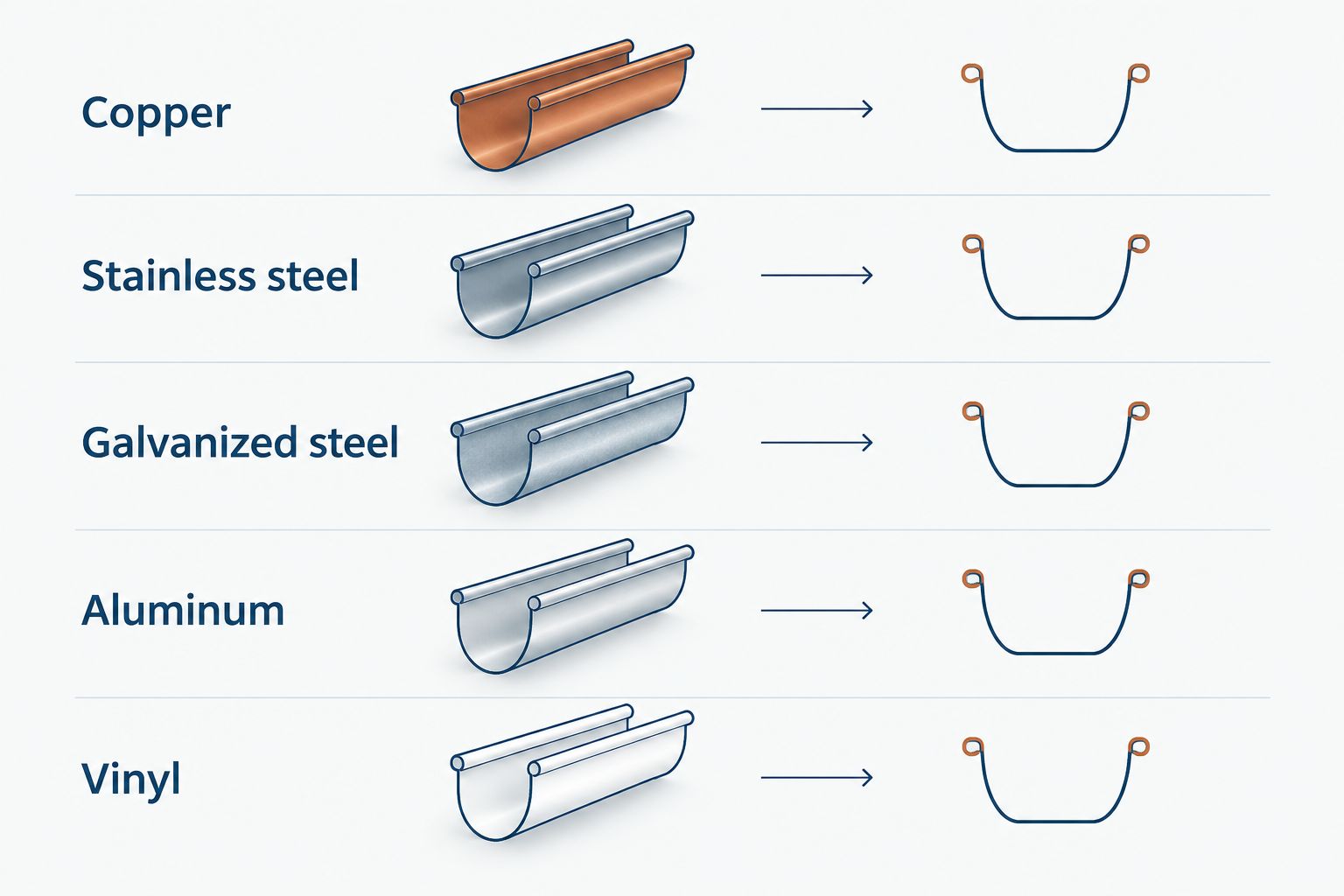
| Rank and material | Best for | Standout feature | Key limitation |
|---|---|---|---|
| 1. Copper | Long-term corrosion resistance | Develops a protective patina | Requires compatible metals and skilled joint work |
| 2. Stainless steel | Corrosion and impact resistance | Resists rust without a galvanized coating | Grade and fabrication quality matter |
| 3. Galvanized steel | Impact resistance with coating upkeep | Steel strength beneath a zinc coating | Damaged or depleted protection exposes steel to corrosion |
| 4. Aluminum | Most residential replacements | Resists red rust and suits seamless fabrication | Dents more readily than steel |
| 5. Vinyl | Projects where avoiding metal is the priority | Does not rust | Becomes more brittle in cold weather |
Material durability and homeowner suitability are different judgments. Copper ranks first here for corrosion resistance, while aluminum remains the practical starting point for most residential comparisons.
1. Copper: best gutter material for corrosion resistance
Copper gutters develop a surface patina rather than the red rust associated with exposed ordinary steel. That makes copper a strong choice when long-term corrosion resistance is your main material requirement.
Copper still needs careful installation. Connections, fasteners and adjoining metals must be compatible; otherwise, the assembly can develop problems despite the gutter material's durability.
Copper pros:
- Does not depend on paint to prevent red rust.
- Develops a protective surface patina.
- Can suit homes where changing metal appearance is welcome.
Copper cons:
- Requires suitable fabrication and joint work.
- Contact with incompatible metals can cause corrosion problems.
- The changing surface color will not suit every homeowner.
Best for: Homeowners prioritizing corrosion resistance and accepting a patina rather than a fixed painted appearance.
Ask how corners, outlets and end connections will be formed and joined. Also ask which fasteners and adjoining metals belong in the assembly; the word copper alone does not answer those questions.
Verdict: Buy for corrosion resistance when the installer specifies compatible components and joint details.
2. Stainless steel: best gutters for impact and corrosion resistance
Stainless steel combines steel's resistance to deformation with corrosion resistance built into the alloy. It does not rely on the same sacrificial zinc coating used on galvanized steel.
The exact stainless grade and exposure still matter. Stainless steel is not a promise that every surface, connection or installation is immune to corrosion.
Stainless steel pros:
- Resists denting better than aluminum of comparable thickness and shape.
- Does not require a galvanized coating for corrosion protection.
- Offers a durable metal option where impact resistance is important.
Stainless steel cons:
- The material specification needs more detail than simply stainless.
- Fabrication and connection methods require appropriate experience.
- Corrosion remains possible under unsuitable exposure or detailing.
Best for: Homeowners who want both impact resistance and corrosion resistance, with a clearly specified assembly.
For a 2026 replacement, request the material grade and connection method in writing. Do not accept a durability claim that names the metal but leaves the actual specification unclear.
Verdict: Buy when impact resistance matters and the contractor can explain the complete stainless assembly.
3. Galvanized steel: best gutters for impact resistance with upkeep
Galvanized steel uses a zinc coating to protect the steel underneath. The steel provides stiffness and impact resistance, while the coating handles corrosion protection.
That distinction matters when comparing galvanized steel with stainless steel. A damaged protective layer creates a different maintenance concern from a dent in a corrosion-resistant metal.
Galvanized steel pros:
- Resists denting better than aluminum of comparable thickness and shape.
- Provides a stiff gutter section.
- Uses a protective zinc layer to delay steel corrosion.
Galvanized steel cons:
- Cut edges and damaged coating need attention.
- Corrosion can develop as the protective layer deteriorates.
- Protective finishes add an inspection and maintenance responsibility.
Best for: Homeowners prioritizing impact resistance who will inspect and maintain the protective finish.
Ask how the installer treats cut edges and what maintenance the specified finish requires. A proposal should distinguish the steel substrate, zinc protection and any additional finish instead of grouping them under a vague description.
Verdict: Buy when impact resistance outweighs the extra coating-maintenance responsibility; skip if you want minimal finish upkeep.
4. Aluminum: best gutter material for most Wisconsin homes
Aluminum is the practical default for a residential gutter comparison because it resists red rust and can be formed into continuous runs. Fewer straight-run seams remove some potential leak locations, although corners, outlets and end caps still need proper connections.
Aluminum is not the toughest metal against impacts. Thickness, gutter shape and attachment details deserve attention before you compare colors or finishes.
Aluminum pros:
- Does not develop red rust like exposed ordinary steel.
- Supports seamless fabrication along straight roof edges.
- Avoids the weight of a comparable steel section.
- Offers a straightforward option for residential replacement.
Aluminum cons:
- Dents more readily than steel of comparable thickness and shape.
- Poorly supported sections can deform under load.
- Seamless construction does not eliminate fitting leaks or maintenance.
Best for: Homeowners seeking a practical balance of corrosion resistance, continuous runs and manageable upkeep.
For an aluminum gutter quote from Liberty Exteriors or another contractor, ask for the material thickness, attachment approach and outlet locations. Those details make the comparison more useful than a promise that one gutter is simply heavy-duty.
Verdict: Buy as the default residential option when the written installation scope addresses support and drainage.
5. Vinyl: best gutters when avoiding metal is the priority
Vinyl gutters do not rust, but rust resistance is only part of winter durability. Vinyl becomes more brittle in cold conditions, and its movement with temperature changes must be accommodated at connections.
For a Wisconsin project focused on durability, those limitations place vinyl behind the metal options. Avoid treating the absence of rust as proof of cold-weather strength.
Vinyl pros:
- Cannot develop metal rust.
- Has no metal coating that needs corrosion repair.
- Offers a nonmetal option where that is a specific requirement.
Vinyl cons:
- Becomes more brittle in cold weather.
- Needs joints that accommodate thermal movement.
- Impact damage can crack a section rather than merely dent it.
Best for: Homeowners with a specific reason to avoid metal who accept the cold-weather trade-offs.
Verdict: Skip when Wisconsin winter durability is your main purchasing criterion.
How the materials were ranked
The ranking emphasizes corrosion resistance first, followed by resistance to damage and dependence on protective coatings. It then considers cold-weather behavior and the demands of maintaining connections and finishes.
This is a material-based comparison, not a controlled product test or a service-life guarantee. Thickness, alloy, coating specification, installation and maintenance can change the outcome. No material earns a fixed lifespan from its name alone.
Maintenance access belongs in your material decision
Choose a gutter you can maintain, not just one with a durable surface. Leaves and debris can obstruct water flow in copper, steel, aluminum or vinyl gutters alike.
For homeowners who cannot safely clear roof-edge debris, the case for low-maintenance gutter guards rests on reducing hands-on cleaning without ignoring inspections. Guards do not turn the underlying gutter into a maintenance-free system or correct a poor drainage layout.
Use 2 inspection checkpoints per year as a planning routine: after spring thaw and after autumn leaf fall. Add an inspection after visible damage or persistent overflow, and arrange ground-based or professional inspection rather than climbing onto an icy roof.
Keep gutter guards separate from the material ranking. Ask how the proposed guard handles the debris around your home, how it is cleaned and whether its attachment affects roof or gutter warranty terms.
Installation details to settle before requesting a quote
The material choice is only useful when the installation scope is clear. For your 2026 project, settle these details before approving the work:
- Fascia condition: Identify deteriorated mounting wood and explain how repairs will be handled.
- Attachment: Specify how the gutters will be supported and attached to suitable structure.
- Drainage layout: Show outlets and downspouts, including where discharged water will go.
- Roof interface: Explain how water leaving the roof reaches the gutter rather than running behind it.
- Connections: Describe corners, end caps, outlets and transitions between materials.
- Warranty responsibility: Separate the material manufacturer's coverage from the installer's workmanship coverage.
Photograph 3 locations before requesting a quote: an overflowing corner, a suspect attachment point and the downspout discharge area. These photographs help explain the problem; they do not replace an inspection.
Ice dams also need a separate diagnosis. A different gutter metal does not correct the roof heat loss and refreezing process that causes an ice dam.
Which gutter material should you choose?
Start with seamless aluminum unless your home has a clear reason to choose another material. Move toward copper for corrosion resistance and its changing appearance, stainless steel for impact resistance without galvanized coating upkeep, or galvanized steel when impact resistance justifies finish maintenance.
Liberty Exteriors is a local gutter installation option for Eau Claire and Chippewa Valley homeowners. Bring the drainage problem and your maintenance limits to the conversation, not just a preferred material name.
Compare 2 written scopes that address the same work. In 2026, a useful comparison specifies material, attachment, fascia repairs, outlets, cleanup and warranty responsibilities; matching only the gutter profile leaves too much unresolved.
FAQ
What's the best gutter material for Wisconsin winters?
Seamless aluminum is the practical default for most residential comparisons, while copper leads this corrosion-focused durability ranking. Installation quality, support and drainage remain essential regardless of material.
Are steel gutters better than aluminum in cold climates?
Steel offers greater resistance to denting than aluminum of comparable thickness and shape. Galvanized steel needs its protective coating maintained, while stainless steel requires a suitable grade and installation specification.
Do copper gutters stop ice dams?
No. Copper gutters do not correct the roof heat loss and refreezing process that causes ice dams. Treat roof icing as a separate building problem rather than a gutter-material problem.
Are vinyl gutters a good choice for Wisconsin?
Vinyl is not the strongest choice when winter durability is the priority. It becomes more brittle in cold weather, and its connections must accommodate temperature-related movement.
Do seamless gutters have any joints?
Yes. Seamless gutters eliminate intermediate seams along continuous runs, but corners, outlets and end caps still need connections. Those locations require proper installation and inspection.
Do gutter guards eliminate winter maintenance?
No. Gutter guards do not eliminate inspections or correct a poor drainage layout. Ask how the proposed guard is cleaned and how its attachment affects the roof and gutter assembly.
What should a gutter quote include in 2026?
A 2026 gutter quote should identify the material, attachment approach, outlet locations, fascia repair scope and cleanup responsibilities. It should also distinguish product warranty coverage from workmanship warranty coverage.
One last thing
A rust-free gutter can still send water behind the fascia. Before approving a replacement, ask the installer to explain the water's complete path from the roof edge to its discharge point; that answer tells you more than the material name alone.