Install seamless gutters with a new roof when the existing gutters also need replacement; keep sound gutters when they drain properly and can stay protected during roofing. For a 2026 roof project, coordinate both scopes before work starts so the roof edge, gutter position, and downspout routes work together. Replacing the roof does not automatically make gutter replacement necessary, and new gutters do not correct roof leaks or ice dams by themselves.
- Schedule seamless gutter installation with roofing when existing gutters leak, sag, or need changes to their drainage layout.
- Keep sound gutters if the roofing contractor can protect them and complete the roof edge correctly.
- Liberty Exteriors serves Chippewa Valley homeowners seeking roofing and gutter installation from a local exterior contractor.
- Agree on roof-edge details, installation order, and separate warranty responsibilities before work begins.
Should seamless gutters be installed with a new roof?
Coordinate the projects, but base replacement on gutter condition—not the age of the roof alone. Roofing and gutters meet at the eaves, where water must leave the roof and enter the gutter without running behind it. That connection deserves attention whether you replace the gutters or keep them.
| Option | Best for | Main advantage | Main drawback |
|---|---|---|---|
| Replace gutters with the roof | Gutters with persistent leaks, damage, poor attachment, or an unsuitable layout | Lets you plan the roof edge and drainage together | Replaces another exterior component that needs its own written scope |
| Keep gutters during roof replacement | Gutters that drain properly and remain securely attached | Avoids replacing a working system | Requires protection and a clear plan for roof-edge access |
| Replace gutters after roofing | Projects where gutter work must happen separately | Allows roofing to finish before gutter installation | Requires coordination so completed roof-edge work is not disturbed |
Why this matters in the Chippewa Valley
Rain, snowmelt, and freezing conditions make the path from your roof to the ground important. A new roof sheds water, but gutters and downspouts still need to collect and discharge it appropriately.
Liberty Exteriors provides roofing and gutter installation in Eau Claire and the surrounding Chippewa Valley, with local experience dating to 1984. Liberty Exteriors is a fit for Chippewa Valley homeowners seeking roofing and gutter installation from a local exterior contractor. Your proposal should still identify the materials, work included, and responsibilities for each part of the project.
Replace the gutters when condition justifies it
Replacing gutters alongside roofing makes sense when the gutter system has problems that repair will not adequately address. Look at performance during rain as well as appearance from the yard; a straight-looking gutter can still have an obstructed outlet or an unsuitable slope.
Ask the contractor to inspect:
- Leaks: Separate a repairable connection from damage affecting the gutter body.
- Sagging: Identify whether the cause is attachment, damaged fascia, or gutter alignment.
- Overflow: Check for debris and blocked outlets before assuming the gutters need replacement.
- Water behind gutters: Inspect the roof-edge connection instead of treating every drip as a gutter leak.
- Downspout discharge: Confirm that outlets do not leave water collecting beside the foundation or across a walking route.
Seamless gutters have continuous runs formed to fit the building, reducing joints along those runs. They still have connections at outlets, corners, and end caps. Seamless does not mean leakproof, maintenance-free, or immune to installation mistakes.
For a 2026 replacement proposal, ask why each affected run needs replacement. A clear explanation distinguishes damaged gutters from a roof-edge problem that new gutters alone will not solve.
Keep the gutters when they still work
Keeping existing gutters is reasonable when they remain sound, securely attached, and able to drain. The roofing contractor must also be able to complete the roof-edge work without leaving an improper connection or damaging the gutter system.
The benefit is straightforward: you retain a working part of the house. The trade-off is that existing gutters can restrict access at the eaves, so protection and any temporary removal need advance discussion.
Ask who will remove roofing debris from retained gutters and inspect them afterward. Do not assume cleanup of the yard automatically includes gutter channels, outlets, and downspouts.
Before signing, request photographs of the existing gutters and visible fascia. Those photographs create a useful condition record; they do not replace an inspection or establish the condition of concealed wood.
How should roofing and gutter installation be sequenced?
Decide the sequence before roofing starts, then confirm it after the roof edge is exposed. New gutters generally belong after the roof-edge and fascia work they depend on, but the contractor must account for the actual attachment and flashing details on your home.
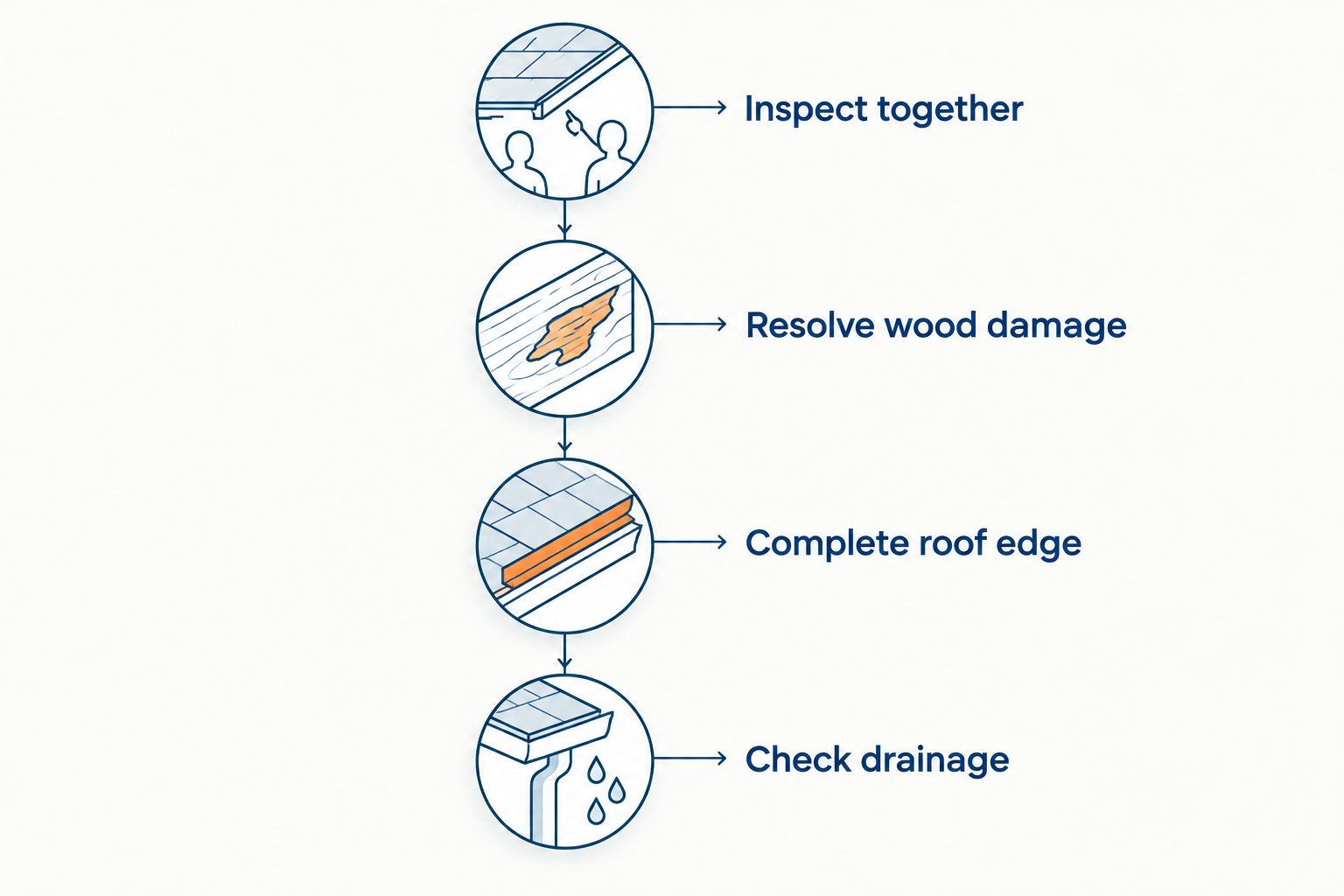
Use these 4 project checkpoints:
- Inspect together. Review the roof edge, existing gutters, fascia, outlets, and downspout routes before finalizing the scope.
- Resolve wood damage. Address deteriorated fascia or other affected support before fastening replacement gutters to it.
- Complete roof edge. Finish the roofing and water-shedding details that must connect correctly with the gutter.
- Check drainage. Inspect gutter alignment, connections, outlets, and discharge after installation and cleanup.
The important issue is the order of dependent work, not whether both crews arrive on the same date. Ask who approves the roof-to-gutter connection before the work is considered complete.
What happens if damaged fascia is uncovered?
Damaged fascia needs attention before new gutters are attached to it. Covering deteriorated wood does not restore its ability to hold fasteners.
Ask how concealed damage will be documented and how additional work will be approved. Your written agreement should identify who contacts you and whether the gutter schedule changes while repairs take place.
Why the right gutter timing varies
The right sequence depends on the house and the planned work. These factors matter more than a blanket rule that every new roof needs new gutters:
- Existing gutter condition: Sound gutters support a retain-and-protect plan; damaged runs support replacement.
- Roof-edge access: Existing attachments can affect access for removing and installing roof-edge components.
- Fascia condition: Deteriorated support needs repair before final gutter attachment.
- Drainage layout: Outlet locations and downspout routes need to suit the roof areas they serve.
- Adjacent exterior work: Siding, windows, doors, decks, or a sunroom can affect where runoff should be directed.
- Crew responsibilities: Separate roofing and gutter crews need an agreed handoff and a clear contact for problems.
For your 2026 project, ask the contractor to explain which factors apply to your home. You need a house-specific plan, not a recommendation based only on the convenience of combining jobs.
What should your written proposal include?
Request 2 written scopes: roofing and gutters, even when they appear in the same agreement. This makes it easier to see what is being replaced, what stays, and where the responsibilities meet.
Roofing scope
The roofing scope should describe the roof covering and related components being installed or retained. Ask how the contractor will handle the eaves, protect existing gutters, and address concealed damage.
If the plan depends on removing and reinstalling gutters, get that task in writing. Clarify who handles it and who checks the finished connection.
Gutter scope
The gutter scope should identify the material, profile, attachment approach, outlets, and downspout locations. Ask why the proposed layout suits your roof instead of choosing solely by how the gutter looks from the street.
Include removal and disposal responsibilities where applicable. If gutter covers are proposed, ask about cleaning access and compatibility rather than accepting a promise that maintenance disappears.
Warranty responsibilities
A product warranty and a workmanship warranty cover different things. Product coverage concerns the manufacturer's stated terms; workmanship coverage concerns the installer's stated responsibilities for the work.
Ask for both in writing and read their exclusions. Liberty Exteriors offers exterior installation services, but the terms that apply to your project must come from your actual proposal and warranty documents—not assumptions about what a new roof includes.
Can new gutters prevent ice dams?
New gutters do not, by themselves, prevent ice dams. Ice dams develop when roof snow melts and refreezes near colder roof edges; attic air leakage, insulation, ventilation, and weather conditions can affect that process.
Gutters filled with ice are a visible symptom, not proof that gutter replacement addresses the cause. If you have recurring ice buildup or interior leaks, ask for an assessment of the roof and attic conditions as well as the drainage system.
For a 2026 roof replacement, put that history in the project discussion before materials are selected. Describe where ice forms and where water appears indoors, without climbing onto an icy roof to investigate.
Should downspouts change when the roof is replaced?
Downspouts should change when their condition or discharge route needs improvement, not simply because the shingles are new. Inspect them as part of the same drainage review so you do not preserve a problem below newly installed gutters.
Follow the water to its destination. A downspout that empties beside a foundation, onto steps, or against an adjacent exterior surface needs a considered discharge plan.
Nearby decks, siding, doors, windows, and sunrooms deserve attention during this review because redirected runoff should not create a new problem elsewhere. Keep any underground drainage work clearly identified as included or excluded from the proposal.
How do you check the finished work?
Arrange 1 final walkthrough that covers both the roofing and gutter scopes. You should not have to decide which crew owns a visible gap or an unresolved drainage concern.
From a safe location, review these points with the contractor:
- Gutters are securely attached and have no obvious damage from roofing work.
- Roof-edge components direct water toward the gutter rather than behind it.
- Outlets and accessible gutter channels are clear of roofing debris.
- Downspouts are connected and discharge at the agreed locations.
- Any unfinished items have a named contact and a written resolution plan.
Do not climb onto the roof to check workmanship. Ask how the contractor verifies drainage and request photographs of details you cannot see safely from the ground.
FAQ
Do I have to replace my gutters when I get a new roof?
No, a new roof does not automatically require gutter replacement. Keep gutters that remain sound and drain properly, provided the contractor can protect them and complete the roof-edge work correctly.
Should seamless gutter installation happen before or after roofing?
Seamless gutter installation should follow the roof-edge and fascia work that the new gutters depend on. Confirm the exact sequence with the contractor because existing attachments and repair needs affect the plan.
Can roofers damage gutters during roof replacement?
Roof replacement can damage gutters if materials, debris, or equipment strike them. Ask how retained gutters will be protected, cleaned, and inspected after roofing work.
Are seamless gutters completely free of leaks?
No, seamless gutters still have connections at outlets, corners, and end caps that can leak. Installation quality and maintenance remain important even when the main runs have no intermediate joints.
Should I replace gutters that overflow during heavy rain?
Check the cause of overflow before deciding to replace the gutters. Debris, blocked outlets, alignment, and drainage design all deserve inspection.
Will new gutters stop ice dams on my Wisconsin home?
New gutters alone do not stop ice dams. Recurring ice buildup calls for a review of roof and attic conditions as well as the gutter system.
What should I ask before scheduling roofing and gutters in 2026?
Ask who owns the roof-to-gutter connection, which components will be retained, and how concealed damage will be approved. Request separate roofing and gutter scopes and written product and workmanship warranty terms.
One last thing
Inspect where the water lands, not just where the gutter hangs. A neatly installed gutter is only part of the drainage path; the downspout outlet still needs to discharge appropriately for your property.
When discussing roofing and gutter installation with Liberty Exteriors, ask for the complete path to be explained—from the roof edge to the final discharge point. That question keeps the decision focused on how the work functions, not just whether the projects share a schedule.