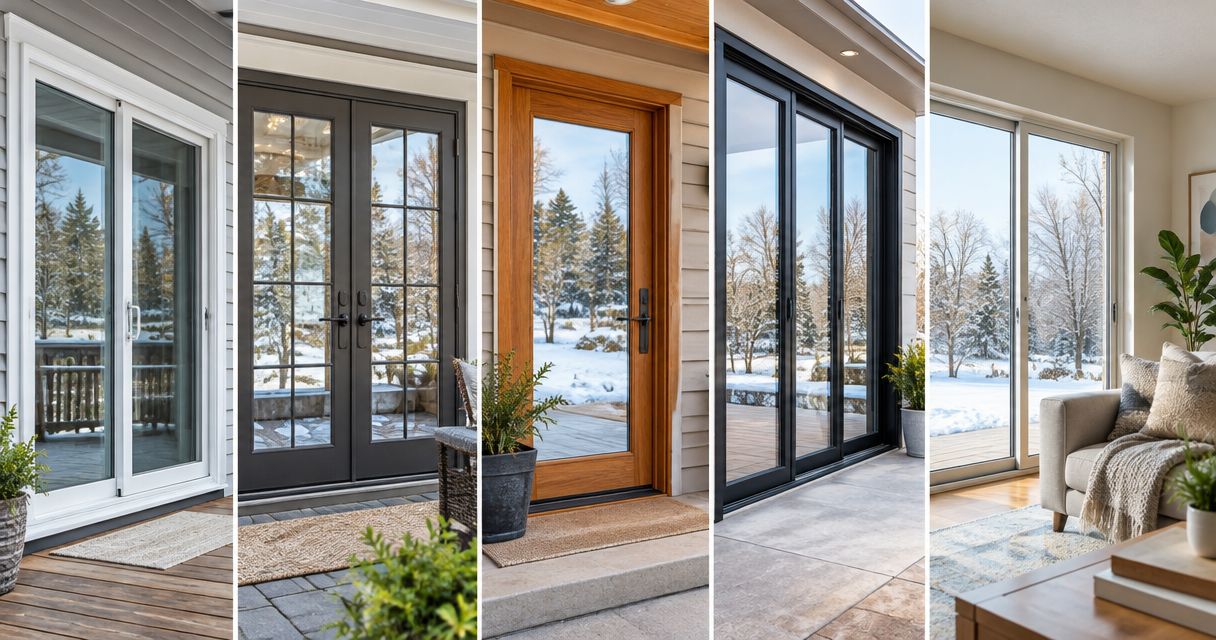
Best starting point: a single hinged patio door when it fits your opening. Best for wider access: double hinged doors. Best for tight spaces: sliding doors. The best patio door styles for energy efficiency depend on whole-door insulation, air-leakage performance and installation—not appearance alone. This 2026 guide ranks styles as a shopping shortlist, not a substitute for comparing rated products.
- Start your search for the best patio door styles for energy efficiency with whole-door ratings, not style names.
- Single hinged doors suit smaller openings; sliding patio doors preserve floor space near furniture.
- Compare U-factor, air leakage and installation details before choosing a patio door for Wisconsin.
- Liberty Exteriors installs doors for homeowners in Eau Claire and the surrounding Chippewa Valley.
Why this matters in Wisconsin
A patio door must do two jobs: keep outdoor conditions outside and provide access you actually use. An insulated door that interferes with your dining table or winter entry routine is the wrong fit.
For a 2026 replacement, separate the product decision from the installation decision. Glass, frame and weatherstripping affect performance, but so do the threshold, flashing and connection to the surrounding wall. Liberty Exteriors provides door installation in Eau Claire, the Chippewa Valley and west central Wisconsin.
Liberty Exteriors is a patio door installation option for homeowners in Eau Claire and the surrounding Chippewa Valley. Choose the style around your opening, then require evidence for its energy performance.
What makes the best energy-efficient patio door?
Use these criteria before comparing styles:
- Whole-door U-factor: Lower values mean less heat transfer through the rated assembly. Compare complete doors, not glass-only figures.
- Air leakage: Look for documented performance for the exact configuration. U-factor does not measure drafts through gaps.
- Glass selection: Low-emissivity coatings, insulating glass and solar heat gain characteristics must suit the opening and exposure.
- Frame construction: Evaluate the complete frame and glass package. A material name alone does not establish efficiency.
- Installation details: Ask how the installer will manage water, support the threshold and seal the opening.
- Everyday operation: You need to close and latch the door fully without fighting furniture, rugs or a difficult threshold.
Do not award an automatic win to fiberglass, vinyl, wood or metal. Frame design and the complete tested assembly matter more than a broad material label.
Patio door styles at a glance
This order prioritizes a straightforward replacement and everyday usability. A lower-ranked style with better documented performance can outperform a higher-ranked style.
| Rank and style | Best for | Standout feature | Key limitation |
|---|---|---|---|
| 1. Single hinged patio door | Smaller openings with swing clearance | One operating panel closes against perimeter seals | Needs clear swing space |
| 2. Double hinged patio doors | Wider access with a traditional appearance | Both leaves can open when configured to do so | Center joint and secondary-leaf hardware need attention |
| 3. Sliding patio door | Rooms where swing space is limited | Panels move along a track | Tracks, interlocks and weatherstripping require inspection |
| 4. Folding or multi-panel patio door | Projects where a broad opening is essential | Multiple panels open a larger portion of the wall | More joints and a more involved opening design |
1. Single hinged patio door: best for a smaller opening
A single hinged patio door swings inward or outward, depending on its design. When latched, the panel closes against weatherstripping around its perimeter.
Start here if you need ordinary patio access rather than a wide entertaining opening. The recommendation concerns a manageable configuration—not a claim that every hinged door beats every slider.
Single hinged patio door pros:
- One operating leaf keeps the closing arrangement straightforward.
- Perimeter seals are accessible for inspection.
- Inward- and outward-opening designs offer different layout choices.
Single hinged patio door cons:
- The swing needs clear space inside or outside.
- A larger existing opening requires a planned combination of door, sidelights or wall changes.
Ask the installer to mark the proposed swing on the floor. Check chairs, curtains, switches and the exterior landing before choosing the handing.
Best for: A homeowner replacing a smaller patio entrance with adequate swing clearance.
Verdict: Buy when the layout works and the exact assembly has suitable ratings. Do not narrow a useful opening solely because a hinged door leads this shortlist.
2. Double hinged patio doors: best for wider access
Double hinged patio doors use two leaves that meet in the middle. Depending on the configuration, one leaf serves everyday traffic while the other opens when you need additional access.
Evaluate the center meeting point closely. Its seals, alignment and locking hardware form part of the door's performance, not just its appearance.
Double hinged patio door pros:
- Opening both leaves provides wider access than the everyday opening alone.
- One leaf can handle routine trips to the patio.
- The paired-door appearance suits homeowners who prefer that layout.
Double hinged patio door cons:
- Door swings compete with furniture and outdoor space.
- The center joint and secondary-leaf hardware add inspection points.
Ask whether the quoted ratings cover the exact double-door configuration. A rating for a single door is not evidence for a different assembly with two operating leaves.
Best for: A homeowner who needs wider occasional access and has room for the swings.
Verdict: Buy for the access benefit; hold if the center-seal details or configuration ratings are unclear.
3. Sliding patio door: best for tight interior layouts
A sliding patio door moves horizontally rather than swinging into the room. A common arrangement combines an operating panel with a fixed panel, though configurations vary.
Sliding doors deserve a place on a 2026 shortlist when furniture sits near the opening. Do not reject the style on reputation alone; compare the actual U-factor and air-leakage information.
Sliding patio door pros:
- No hinged leaf swings across the indoor floor.
- The layout works beside dining areas and compact seating arrangements.
- Large glass panels maintain a view when the door is closed.
Sliding patio door cons:
- The clear passage is smaller than the full frame width in a fixed-and-sliding arrangement.
- Track debris, worn weatherstripping and poor alignment need attention.
Operate the display door if possible. Check the effort needed to slide, close and lock it, and ask how the rollers and seals are serviced.
Best for: A homeowner whose room layout makes a swinging door impractical.
Verdict: Buy when space is the constraint and the documented performance meets your requirements. A well-chosen slider is a better decision than a hinged door you cannot comfortably use.
4. Folding or multi-panel doors: best for a broad opening
Folding and multi-panel systems move several panels to create a larger connection between the house and patio. The opening arrangement depends on the system; folding panels and sliding stacks do not operate identically.
Treat this as a remodeling decision rather than a simple style upgrade. The opening, support, threshold and weather protection all need a coordinated plan.
Folding or multi-panel door pros:
- Opens a larger portion of the wall than a conventional fixed-and-operating arrangement.
- Offers panel layouts that suit different access goals.
- Connects indoor and outdoor gathering spaces when open.
Folding or multi-panel door cons:
- Multiple panel joints create more seals and hardware to inspect.
- Changing the opening can involve structural and water-management work.
Request performance information for the full panel arrangement, not a smaller example from the same product family. Confirm that the installer handles the proposed system; this guide does not establish which configurations Liberty Exteriors offers.
Best for: A homeowner whose main requirement is a broad opening and who accepts a more involved project.
Verdict: Hold until the opening design, exact ratings and installation responsibilities are documented.
How this ranking works
The ranking follows the criteria above: sealing arrangement, installation demands and everyday operation. It is a decision order, not laboratory testing or a measured efficiency leaderboard.
For a 2026 project, compare at least 2 complete door proposals using the same opening dimensions and operating arrangement. Otherwise, differences in glass area, sidelights or panel count can obscure what you are comparing.
Read the ratings before choosing the style
Whole-door ratings let you compare the proposed assemblies rather than sales descriptions. Keep the configuration attached to every figure: glass package, frame, panel arrangement and size where applicable.
Use 3 checks when reviewing a proposal:
- Heat transfer: Compare whole-door U-factor. Lower is better for limiting heat flow through the assembly.
- Air leakage: Request the published result and test basis. Do not treat an insulation figure as a draft rating.
- Solar exposure: Review the solar heat gain coefficient alongside orientation, shade and comfort needs.
The same distinction applies when comparing door insulation ratings: a heat-transfer value describes the rated assembly, while seals and installation require separate scrutiny. Keep those questions separate in your patio-door comparison.
For your 2026 purchase, ask whether the exact product meets current ENERGY STAR requirements for your location. Certification helps identify qualifying products; it does not replace a sound installation or establish savings for your house.
Make installation part of the decision
A door replacement connects glass, framing, siding, flooring and the outdoor landing. Ask the contractor to explain that connection before choosing the finish or handle.
Use these 4 installation checks during the site visit:
- Opening condition: Identify damaged framing, staining or soft material that needs investigation before the new door goes in.
- Water management: Explain how flashing and the threshold will direct water outward and connect with the wall's drainage details.
- Air sealing: Describe how the gap between the frame and wall will be insulated and sealed without distorting the frame.
- Final operation: Confirm that the door closes, locks and drains as intended after installation.
A clear sequence keeps concealed work from becoming an afterthought. Opening condition comes first; trim and finish work cannot correct an unresolved water problem behind the frame.

If the patio door meets a deck, check how water moves at the threshold and whether the landing leaves room for operation. If it connects to a sunroom, establish whether that room is conditioned before applying the same comfort expectations as the main house.
Liberty Exteriors has served the area since 1984. When discussing a replacement, ask about the proposed installation scope as well as the door itself; the company's background provides context, not a substitute for project-specific details.
Questions to settle before requesting a quote
Give each contractor the same description of the opening and your priorities. That makes proposals easier to compare without assuming that similar-looking doors include the same work.
Ask these questions:
- What exact door configuration and glass package does the proposal include?
- Which whole-door ratings apply to that configuration?
- Will the opening stay the same size?
- What happens if concealed framing damage appears during removal?
- Who handles interior trim, exterior trim and surrounding siding repairs?
- What product warranty applies, and what workmanship warranty applies separately?
- How will the completed door's operation be checked?
Keep product and workmanship warranties distinct in your 2026 paperwork. A manufacturer's coverage for a component does not automatically describe the contractor's responsibility for installation.
Which patio door style should you choose?
Choose a single hinged patio door as your default only when the opening and swing space suit it. Choose double hinged doors for wider access, sliding doors to protect usable floor space, and folding or multi-panel systems when a broad opening justifies the added planning.
Then let documented performance settle the energy question. Style helps narrow the field; whole-door ratings and installation details determine whether a particular proposal deserves your approval.
FAQ
What's the best patio door style for energy efficiency in Wisconsin?
No patio door style is automatically the most energy efficient. Start with a single hinged door when it suits the opening, then compare exact whole-door U-factors, air-leakage information and installation details against other suitable options.
Are hinged patio doors more energy efficient than sliding doors?
A hinged door is not automatically more energy efficient than a sliding door. Hinged doors close against perimeter seals, while sliding doors use track and interlock arrangements; compare the actual rated assemblies rather than assuming a winner.
What does a lower patio door U-factor mean?
A lower U-factor means less heat transfer through the rated door assembly. Use whole-door figures for comparison, because glass-only figures do not describe the complete frame and door.
Should I choose double-pane or triple-pane patio door glass?
Choose the glass package by comparing the complete door's performance and suitability for your opening. Pane count alone does not establish the best choice; coatings, frame construction, operating weight and whole-door ratings also matter.
Can a new patio door fix drafts around the opening?
A replacement can address drafts when the project corrects their cause. Ask the installer to distinguish worn door seals from gaps around the frame or problems in the surrounding wall.
Are French patio doors a good choice for Wisconsin homes?
Double hinged French patio doors are a practical choice when you need wider access and have adequate swing clearance. Check the center seals, secondary-leaf hardware and ratings for the exact configuration before choosing them.
Does Liberty Exteriors install patio doors in Eau Claire?
Liberty Exteriors provides door installation services in Eau Claire and the surrounding Chippewa Valley. Ask which patio door styles and configurations are offered for your particular opening.
One last thing
Practice closing and locking the door before deciding. A strong performance label does not help if the door is routinely left partly latched because its operation is awkward. Put everyday usability on the same checklist as insulation.