Best overall shortlist: fiberglass. Best for straightforward replacement: vinyl. Best for traditional interiors: wood. These are the best window materials for energy efficiency to compare for Wisconsin homes in 2026—but the whole-window rating, not the frame material alone, decides which window insulates better.
- The best window materials for energy efficiency need whole-window ratings; frame names alone cannot establish a winner.
- Fiberglass leads the shortlist for dimensional stability; vinyl deserves consideration for straightforward replacement projects.
- Wood suits traditional interiors; composite construction needs a closer look at the specific frame design.
- Liberty Exteriors serves Wisconsin homeowners comparing replacement windows; request ratings and installation details together.
Why this matters in Wisconsin
A window is more than its frame. Glass, spacers, weatherstripping and the connection to the wall all affect how the finished opening performs. A well-rated window still needs careful installation.
For Eau Claire and Chippewa Valley homeowners planning a 2026 replacement, the useful question is not simply which material is warmest. Ask which complete window meets your insulation needs, fits the opening and comes with an installation scope you understand.
Liberty Exteriors is a window installation contractor for homeowners in Eau Claire and the surrounding Chippewa Valley. The company has served the area since 1984. Use the material shortlist below to prepare questions, then compare the actual windows proposed for your home.
What makes the best energy-efficient window material?
Judge the complete window against these criteria before choosing a frame:
- Whole-window U-factor: Lower values mean less heat transfer through the window. Compare complete-window ratings, not center-of-glass figures.
- Air leakage: Ask for the rated air leakage and how the installer will seal the opening. This measures something different from U-factor.
- Frame stability: Frames must accommodate temperature changes without compromising operation or weather seals.
- Moisture management: Exterior finishes, drainage paths and flashing must keep water from damaging the opening.
- Maintenance: Decide whether periodic painting, staining or finish inspection fits your plans.
- Installation fit: Confirm whether the quote covers an insert replacement or removal of the existing frame. That choice changes what the installer can inspect.
A material earns its place on your shortlist by fitting these requirements. It does not earn an energy-efficiency claim simply because its name appears on a brochure.
Window materials at a glance
This is a practical selection order, not a measured ranking of every window sold. A vinyl window with a lower whole-window U-factor transfers less heat than a fiberglass window with a higher one.
| Rank and material | Best for | Standout characteristic | Key limitation |
|---|---|---|---|
| 1. Fiberglass | A dimensionally stable replacement frame | Limited expansion and contraction with temperature changes | Material alone does not establish thermal performance |
| 2. Vinyl | Straightforward replacement projects | No painted finish required on typical unpainted frames | Frame design and reinforcement vary |
| 3. Wood | Traditional interior appearance | Naturally insulating frame material | Exposed wood needs finish maintenance |
| 4. Composite | Comparing alternatives to conventional frames | Can combine materials for particular frame properties | The label covers different constructions |
| 5. Thermally broken aluminum | Projects requiring metal frames | A thermal break interrupts the metal's conductive path | An uninterrupted metal frame conducts heat readily |
1. Fiberglass: best for dimensional stability
Fiberglass belongs at the top of a Wisconsin replacement-window shortlist when frame stability is a priority. It expands and contracts less with temperature changes than vinyl, but that property does not automatically produce the lowest U-factor.
For a 2026 project, compare the exact fiberglass model against other complete windows. Ask about its glass package, operating style and frame dimensions rather than treating the material as a performance certificate.
Fiberglass pros:
- Limited thermal expansion supports dimensional stability.
- The material does not rot like exposed wood.
- It offers an alternative to both wood and vinyl construction.
Fiberglass cons:
- Fiberglass construction does not guarantee better insulation than another rated window.
- Finish care and repair instructions depend on the specific product.
Best for: Homeowners who prioritize frame stability and want to compare complete-window ratings across materials.
Ask whether the proposed finish needs maintenance and how damaged surfaces are repaired. Also check whether the exact window size and operating style carry the rating shown in the proposal.
Verdict: Buy fiberglass when its documented performance and installation scope fit your project—not for the material name alone.
2. Vinyl: best for straightforward replacement projects
Vinyl is a practical starting point when you want replacement windows without maintaining a painted wood frame. Hollow frame chambers and the overall profile influence performance, so two vinyl windows need not insulate equally well.
Inspect a sample if possible. Look at how much frame surrounds the glass, operate the sash and ask how reinforcement affects the proposed window's ratings.
Vinyl pros:
- Typical unpainted vinyl frames do not require painting.
- Vinyl does not rot like wood.
- Different frame and glass configurations give you several performance choices.
Vinyl cons:
- Vinyl expands and contracts with temperature changes.
- Bulky frame profiles can reduce visible glass, especially with insert replacements.
Best for: Homeowners seeking a straightforward replacement with limited frame-finish maintenance.
Do not assume that thicker-looking vinyl means better insulation. Request the whole-window U-factor and ask whether the sample matches the window in your quote. Check painting restrictions before planning a future color change.
Verdict: Buy vinyl when the complete window meets your performance needs and preserves enough glass area.
3. Wood: best for traditional interior appearance
Wood is naturally insulating and suits homes where interior trim and traditional proportions matter. Its energy performance still depends on the full window assembly, including glass, seals and spacers.
Some wood windows have exterior cladding. That changes the exposed exterior surface, but it does not remove the need to inspect joints, finishes and drainage details.
Wood pros:
- Wood provides a naturally insulating frame.
- Interior surfaces can suit painted or stained trim schemes.
- Traditional profiles can complement existing architectural details.
Wood cons:
- Exposed wood requires finish maintenance.
- Persistent moisture can damage wood when protective finishes or water-management details fail.
Best for: Homeowners who prioritize traditional interiors and accept the maintenance requirements.
For your 2026 comparison, distinguish an all-wood exterior from a clad-wood exterior. Ask which surfaces remain exposed, what maintenance the manufacturer requires and whether the warranty excludes damage connected to neglected finishes.
Verdict: Buy wood for its interior fit and documented window performance; skip it if required finish maintenance is unrealistic.
4. Composite: best for comparing alternative frame designs
Composite is a broad description, not a single recipe. Depending on the manufacturer, it can describe a blend of materials or an assembly that uses different materials in different parts of the frame.
That makes the construction details especially important. Ask what the frame contains, which surfaces face the weather and how the manufacturer expects you to maintain them.
Composite pros:
- Composite construction can combine properties of different materials.
- It provides alternatives to conventional wood, vinyl or metal frames.
- Complete-window ratings allow a direct thermal comparison despite different construction methods.
Composite cons:
- The word composite does not identify one consistent material or performance level.
- Finish care and repair methods depend on the actual construction.
Best for: Homeowners willing to compare a specific frame design rather than shop by a familiar material label.
Do not accept composite as an explanation by itself. Request a frame cross-section or written description, then compare the same operating style and glass configuration against other proposals.
Verdict: Hold until the frame construction, maintenance instructions and whole-window ratings are clear.
5. Thermally broken aluminum: best for metal-frame requirements
Aluminum conducts heat readily. A thermally broken frame interrupts that conductive path with a less-conductive material, which makes the frame construction central to an energy-efficiency comparison.
Aluminum deserves consideration when a project specifically calls for metal framing. It is not the default choice for a Wisconsin homeowner whose main objective is reducing heat transfer.
Thermally broken aluminum pros:
- Aluminum provides strength and rigidity.
- Metal construction can support slender frame designs.
- A thermal break reduces conduction compared with an uninterrupted metal path.
Thermally broken aluminum cons:
- Metal remains a conductive material, making the thermal-break design important.
- A thermally broken label still does not establish the complete window's U-factor.
Best for: Projects with an architectural or structural reason to use metal frames.
Ask the supplier to identify the thermal break and provide the complete-window rating. Interior condensation also depends on indoor humidity and surface temperature; a material label cannot promise condensation-free glass.
Verdict: Skip aluminum as the default energy-first choice; consider a rated, thermally broken design when metal framing serves a specific need.
Glass and installation can change the ranking
Double-pane windows have 2 panes of glass; triple-pane windows have 3 panes of glass. Additional glazing creates another insulating space, but pane count alone does not establish the finished window's performance. Compare the whole-window U-factor for the actual configurations offered.
Low-emissivity coatings affect heat transfer through the glass. Solar heat gain coefficient, or SHGC, describes how much solar heat passes through the window. Neither specification replaces the other, and Wisconsin homes need attention to both winter insulation and summer comfort.
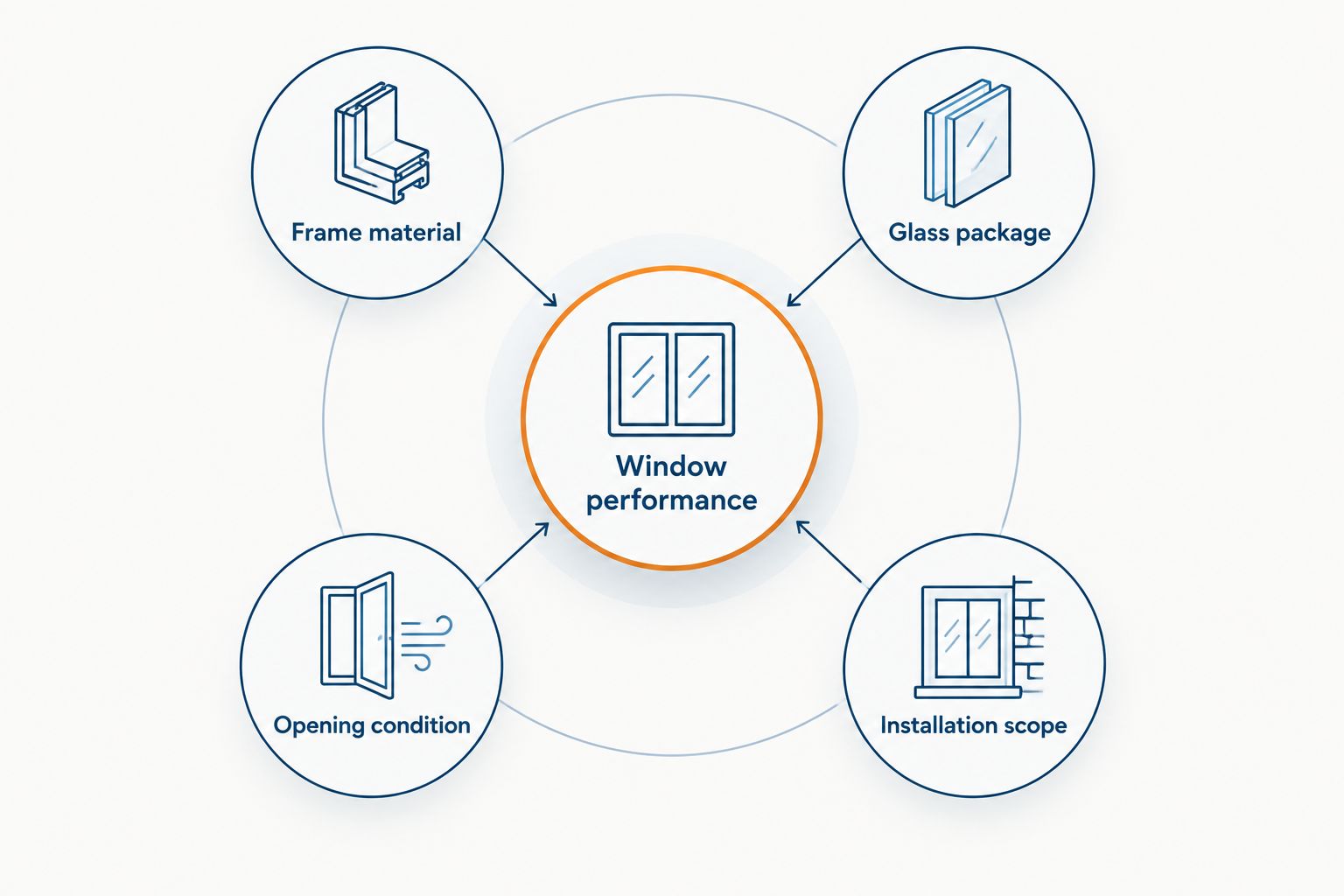
For a 2026 quote, separate these decisions:
- Frame material: Choose construction and maintenance requirements that suit your home.
- Glass package: Compare U-factor, SHGC and visible light transmission for the proposed configuration.
- Opening condition: Identify damaged framing, failed flashing or other conditions before covering them.
- Installation scope: Confirm insulation, air sealing, flashing and trim work in writing.
An insert replacement keeps the existing frame in place. A full-frame replacement removes it, allowing inspection of more of the opening. Neither approach is automatically right for every house; the condition of the existing frame should guide that decision.
Coordinate nearby exterior work, too. Siding affects access to window flashing, while roof and gutter problems can direct water toward walls. Door, deck and sunroom projects also need clear connection details where they meet the house.
Questions to ask before accepting a window quote
You do not need to become a window specialist. You need answers that connect the proposed product to the work at your house.
Ask these questions before signing:
- What exact window model, operating style and glass package are included?
- What are the whole-window U-factor and SHGC?
- Does the quoted configuration qualify for the applicable ENERGY STAR climate zone?
- Will the existing frame stay or be removed?
- How will you handle damaged wood discovered during removal?
- What flashing, insulation, air sealing and trim work are included?
- Who handles service requests after installation?
Request 2 warranty documents when separate product and workmanship coverage applies. The product warranty addresses the manufacturer's stated coverage; the workmanship warranty addresses the installer's stated coverage. Read exclusions and claim procedures rather than assuming either covers everything.
Liberty Exteriors provides window installation services along with siding, roofing, doors, gutters, decks and sunrooms. When projects overlap, ask for a written sequence that explains who handles the connections between them.
How these materials were ranked
This 2026 shortlist prioritizes frame stability, maintenance demands, moisture considerations and suitability for residential replacement. It does not assign invented energy scores or assume all windows made from one material perform alike.
The actual efficiency winner is the proposed window with the better relevant whole-window ratings, supported by appropriate installation. Use the material ranking to narrow your search, then let documented performance decide between specific models.
Which window material should you choose?
Start with fiberglass and vinyl if you have no architectural requirement for another material. Compare wood when traditional interiors matter, composite when its construction offers a useful fit, and thermally broken aluminum when the project needs metal framing.
For an undecided Wisconsin homeowner, compare a fiberglass window and a vinyl window with clearly identified glass packages and matching installation scopes. Choose between those complete proposals—not between material names in isolation.
FAQ
What's the best window material for energy efficiency in Wisconsin?
No frame material is always the most energy efficient. Start by comparing fiberglass and vinyl, then use the proposed windows' whole-window U-factors and installation details to choose.
Are fiberglass windows more energy efficient than vinyl windows?
Fiberglass windows are not automatically more energy efficient than vinyl windows. Fiberglass has limited thermal expansion, but the complete window's rated U-factor determines its resistance to heat transfer.
Are triple-pane windows always better than double-pane windows?
Triple-pane construction alone does not establish which complete window performs better. Compare whole-window U-factor, solar heat gain coefficient and the suitability of each configuration for your home.
Are wood windows a bad choice for Wisconsin winters?
Wood windows are not inherently a bad choice for Wisconsin winters. Wood is naturally insulating, but the complete window needs suitable ratings, careful installation and required finish maintenance.
Should I replace the entire window frame?
The condition of the existing frame should guide whether it stays or is removed. Ask the installer to explain how the proposed approach addresses damage, flashing and air sealing.
Does an ENERGY STAR label replace the need to compare window ratings?
An ENERGY STAR label does not replace a comparison of the actual window ratings. Check qualification for the applicable climate zone and compare the configurations listed in your proposals.
Does Liberty Exteriors install windows in the Chippewa Valley?
Liberty Exteriors provides window installation services in Eau Claire, the Chippewa Valley and west central Wisconsin. Its exterior improvement services also include siding, roofing, doors, gutters, decks and sunrooms.
One last thing
Before accepting a quote, ask the installer to identify the exact rated window configuration in writing. A sample, a brochure and a proposal can describe different glass packages. Matching those details is a simple way to make sure the performance you compared belongs to the window you are ordering.