Best overall: capped composite. Best for avoiding refinishing: PVC. Best for a natural wood surface: cedar. The best deck materials for Wisconsin weather depend on how much upkeep you will actually do; this 2026 guide from Liberty Exteriors ranks the choices by maintenance and explains their trade-offs.
- The best deck materials for Wisconsin weather balance moisture resistance, cleaning, traction, and repair needs.
- Capped composite is the default recommendation for homeowners who want less refinishing than wood requires.
- PVC avoids wood-related decay in the deck boards, but heat, movement, and installation details still matter.
- Liberty Exteriors recommends comparing deck materials alongside drainage, framing condition, and a written maintenance plan.
Why this matters
Wisconsin decks face snow, wet leaves, summer sun, and repeated freezing and thawing. Your material choice affects the work above the framing, but it does not replace proper drainage, secure connections, or sound construction.
Low maintenance means less finishing—not permission to ignore the deck. Leaves still collect between boards, shaded surfaces still need cleaning, and stairs still need attention when ice forms. A neglected composite or PVC deck is not automatically safer or cleaner than a maintained wood deck.
Liberty Exteriors has served Eau Claire and the surrounding Chippewa Valley since 1984. For a 2026 deck project, start with the condition of the structure and your willingness to maintain the surface, then choose the material.
What makes the best deck materials for Wisconsin weather?
Use these criteria before comparing colors or board profiles:
- Finishing requirements: Does the surface need stain or another protective finish, or mainly cleaning?
- Moisture response: How does the material handle damp conditions, and where must water escape?
- Cleaning needs: Can you remove leaves, dirt, food spills, and winter residue using approved methods?
- Comfort and traction: How does the specific board feel in direct sun and when wet?
- Repair options: Can a damaged board be replaced without disturbing large sections of the deck?
- Installation requirements: What framing, fasteners, clearances, and spacing does the selected product require?
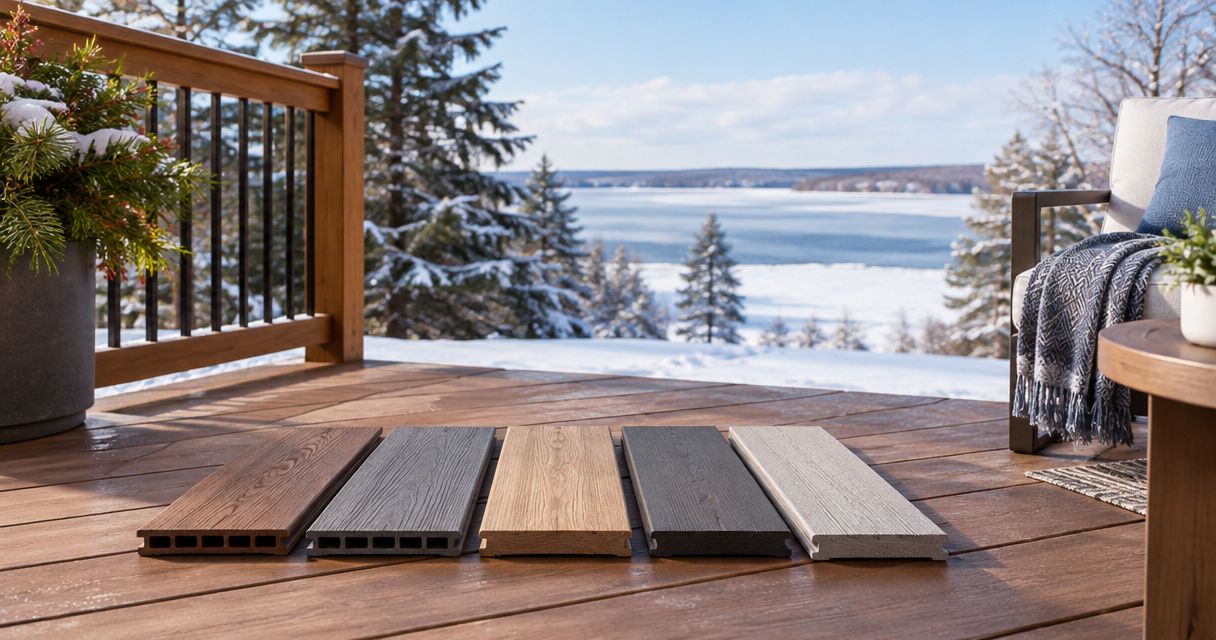
Ask for 2 sample boards in the colors you are considering. Put them where the deck will sit, compare their feel in sun and shade, and inspect the surface after wetting it. Samples help you judge comfort and appearance; they do not establish a slip-resistance rating.
Deck materials at a glance
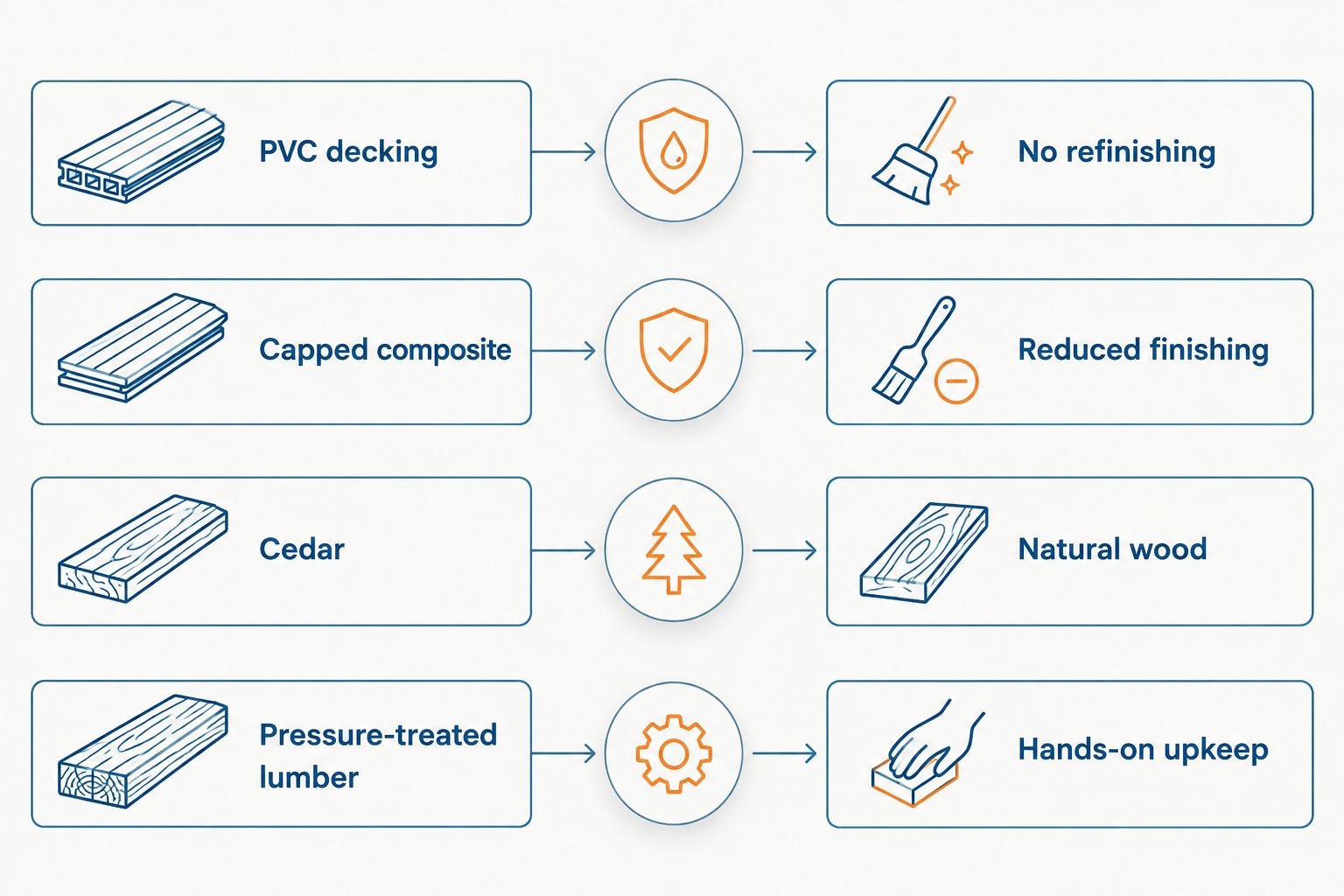
This 2026 ranking puts freedom from recurring refinishing first. Capped composite remains the overall recommendation because it offers a practical middle ground between a wood appearance and reduced finishing work.
| Upkeep rank | Material | Best for | Standout feature | Key limitation |
|---|---|---|---|---|
| 1 | PVC decking | Avoiding wood-related board decay and refinishing | Deck boards contain no wood fiber | Temperature movement and surface heat need attention |
| 2 | Capped composite | Balancing appearance with reduced finishing | Protective cap over a wood-plastic core | Cap coverage and care instructions vary by product |
| 3 | Cedar | Homeowners who want natural wood | Real wood grain and a surface that can be refinished | Requires finish decisions, cleaning, and wood repairs |
| 4 | Pressure-treated lumber | Homeowners comfortable with hands-on upkeep | Preservative treatment helps resist decay | Can check, splinter, and move as it weathers |
The ranking covers deck boards, not the entire assembly. Railings, stairs, framing, connections, and the area beneath the deck have separate maintenance needs.
1. PVC decking: best for avoiding recurring refinishing
PVC decking uses plastic rather than a wood-fiber core. The boards do not need wood stain, and wood-decay fungi do not consume PVC as they do wood. That makes PVC a strong candidate when avoiding recurring surface finishing is your priority.
The installation still needs to account for temperature-related movement. Board spacing, fastening, and framing support must follow the selected manufacturer's instructions—not a generic detail carried over from a wood deck.
PVC decking pros:
- Does not need recurring wood staining.
- Avoids wood-related decay within the deck boards themselves.
- Does not develop wood splinters as lumber can.
PVC decking cons:
- Can become uncomfortable under bare feet in direct sun; color and product matter.
- Expands and contracts with temperature changes, making installation details important.
- Scratches and other surface damage are not repaired like a sanded wood board.
Best for: Homeowners who want to avoid refinishing and accept routine cleaning, careful product selection, and product-specific repair limits.
Ask what cleaners, snow-removal tools, and ice-control products the manufacturer permits. Do not assume a product approved for concrete is approved for PVC.
Verdict: Buy PVC decking when avoiding refinishing matters more than having a real wood surface.
2. Capped composite: best for balanced everyday upkeep
Capped composite combines a wood-plastic core with a protective outer layer. It is the default recommendation for homeowners who want a wood-look deck without planning their weekends around staining.
The word capped does not describe every product identically. Cap coverage, fastening requirements, cleaning methods, and warranty terms need checking for the actual board being quoted.
Capped composite pros:
- Usually requires cleaning rather than recurring staining.
- Offers wood-look surfaces without exposed lumber across the walking surface.
- Avoids the routine splinter management associated with weathering wood boards.
- Provides a clear product-specific maintenance routine when instructions are supplied.
Capped composite cons:
- Leaves, dirt, and organic buildup still need removal.
- Dark surfaces can become hot in direct sun.
- Deep damage can require board replacement rather than a simple refinishing repair.
Best for: Homeowners who want reduced finishing work and a wood-look surface without choosing natural lumber.
For a 2026 quote, ask the installer to identify the exact board, cap construction, approved fasteners, and required joist spacing. A material category is not a complete specification.
Verdict: Buy capped composite as the default choice when reduced upkeep and appearance carry similar weight.
3. Cedar: best for homeowners who want natural wood
Cedar gives you actual wood grain, not a manufactured wood pattern. It also gives you decisions that synthetic boards largely avoid: whether to preserve a chosen color with a finish or accept weathering and color change.
Cedar has natural decay resistance, but that does not make every board immune to deterioration. Persistent moisture, trapped debris, and poor detailing still need correction.
Cedar pros:
- Provides a natural wood surface and grain.
- Can be cleaned and refinished when its condition allows.
- Allows individual damaged boards to be replaced.
Cedar cons:
- Changes color with exposure unless managed with an appropriate finish.
- Can develop checks, splinters, and localized decay.
- Needs ongoing inspection and maintenance rather than a cleaning-only mindset.
Best for: Homeowners who value real wood enough to accept finish maintenance and periodic repairs.
Ask what preparation the proposed finish requires and how you should judge when maintenance is due. Avoid a fixed refinishing promise that ignores sun exposure, wear, moisture, and the finish manufacturer's directions.
Verdict: Buy cedar for its natural wood character; skip cedar if avoiding upkeep is your main goal.
4. Pressure-treated lumber: best for hands-on maintenance
Pressure-treated lumber is wood treated with preservatives to improve resistance to decay and certain insect damage. Treatment does not prevent every problem associated with outdoor wood.
Boards still respond to moisture. Checking, movement, roughness, and splinters require attention as the deck weathers, particularly where people walk barefoot or hold the railing.
Pressure-treated lumber pros:
- Uses familiar wood construction and repair methods.
- Allows replacement of individual damaged boards.
- Accepts suitable finishes when the wood is properly prepared and ready.
Pressure-treated lumber cons:
- Can check, warp, and splinter as moisture conditions change.
- Needs compatible fasteners and connectors.
- Requires ongoing surface inspection and finish maintenance when finished.
Best for: Homeowners willing to handle cleaning, finish preparation, and occasional board repairs themselves or arrange that work.
Do not judge readiness for finishing by a calendar date alone. Follow the lumber and finish instructions, including any moisture or preparation requirements.
Verdict: Buy pressure-treated lumber only if you accept wood upkeep; skip it for a low-refinishing brief.
Installation details that matter more than the brochure
A durable deck starts below the walking surface. Changing board material does not repair weak framing, a failing connection to the house, or water entering behind exterior finishes.
Before approving a 2026 resurfacing project, ask the contractor to address these areas:
- Framing condition: Identify deterioration and confirm the structure suits the proposed decking.
- Water drainage: Explain how water escapes at board gaps and near the house.
- House connection: Inspect the attachment and flashing where the design uses a ledger.
- Stairs and railings: Check their condition and applicable requirements separately from the boards.
- Surface fastening: Specify compatible hardware and the selected product's installation method.
The connection to the house also affects adjacent siding, doors, and gutters. Water should not be directed into a vulnerable wall connection or onto a deck entry. Decks and sunrooms need their own structural and enclosure planning; a new surface is not a substitute.
Keep roofing, window, and door concerns separate in the quote when they need separate work. Clear scopes prevent a deck-board decision from hiding another exterior problem.
Make upkeep part of the written quote
Ask Liberty Exteriors to separate the deck proposal into 3 written sections: structure, surface materials, and maintenance responsibilities. That makes it easier to compare the work rather than just the board name.
Request 1 written care plan for the selected surface. It should identify approved cleaning methods, snow-removal guidance, and actions that can damage the material or affect warranty coverage.
Keep product warranties separate from workmanship warranties. A manufacturer's coverage concerns its product under stated terms; installation coverage concerns the contractor's work under its own written terms. Neither label tells you everything without the exclusions and claim procedure.
Use these questions before requesting the final quote:
- What exact decking product and color are included?
- What framing repairs or changes are included or excluded?
- How will the crew handle the connection to the house?
- Which maintenance tasks remain my responsibility?
- What product and workmanship coverage is documented separately?
How the materials were ranked
This ranking compares maintenance tasks, not unsupported lifespan promises or test scores. Freedom from refinishing comes first, followed by moisture-related board concerns, cleaning, surface comfort, and repair needs.
PVC ranks first for avoiding wood-related board decay and finishing. Capped composite earns the overall recommendation for homeowners balancing reduced upkeep with a wood-look surface. Cedar and pressure-treated lumber suit buyers who deliberately choose real wood and accept its maintenance.
Which deck material should you choose?
Choose capped composite if you want a sensible starting point for a lower-upkeep deck in 2026. Compare the actual board's care instructions, surface feel, cap coverage, and installation requirements before making the final selection.
Choose PVC when avoiding refinishing and wood-related board decay is your priority. Choose cedar for natural wood character. Choose pressure-treated lumber when you are comfortable managing a working wood surface rather than trying to eliminate its upkeep.
Do not buy a material category on reputation alone. Buy a specified product installed over a suitable structure, with maintenance responsibilities you understand.
FAQ
What's the best deck material for Wisconsin weather?
Capped composite is the default recommendation for homeowners balancing reduced upkeep with a wood-look surface. PVC is a stronger fit when avoiding wood-related board decay and refinishing is the main priority.
Is PVC decking better than composite for Wisconsin winters?
PVC is not automatically better than capped composite for every Wisconsin deck. Both need product-specific installation, drainage, cleaning, and approved snow-removal methods; PVC also needs careful allowance for temperature-related movement.
Can I leave a composite deck outside all winter without maintenance?
A composite deck still needs maintenance during winter. Keep drainage paths clear and follow the board manufacturer's instructions for snow removal, cleaners, and ice-control products.
Does cedar decking need to be stained every year?
Cedar does not have a universal annual staining requirement. Maintenance depends on exposure, wear, the chosen finish, and whether you want to preserve a particular color rather than accept weathering.
Can new composite boards go on my existing deck frame?
New composite boards belong on existing framing only when its condition and layout meet the selected product's requirements and applicable construction requirements. The framing, connections, stairs, and railings need assessment before resurfacing.
Will a product warranty cover installation problems?
A product warranty does not automatically cover installation problems. Ask for the manufacturer's terms and the contractor's workmanship terms separately, including exclusions and the process for reporting a problem.
What should I ask Liberty Exteriors before choosing deck boards?
Ask Liberty Exteriors to identify the exact decking product, required framing work, maintenance instructions, and separate warranty terms. Also ask how the proposed design handles water where the deck meets the house.
One last thing
Look beneath the deck before choosing what goes on top. An attractive board cannot correct an unsound connection or stop water entering the house. For your 2026 project, settle the structure and drainage first; the color decision can follow.